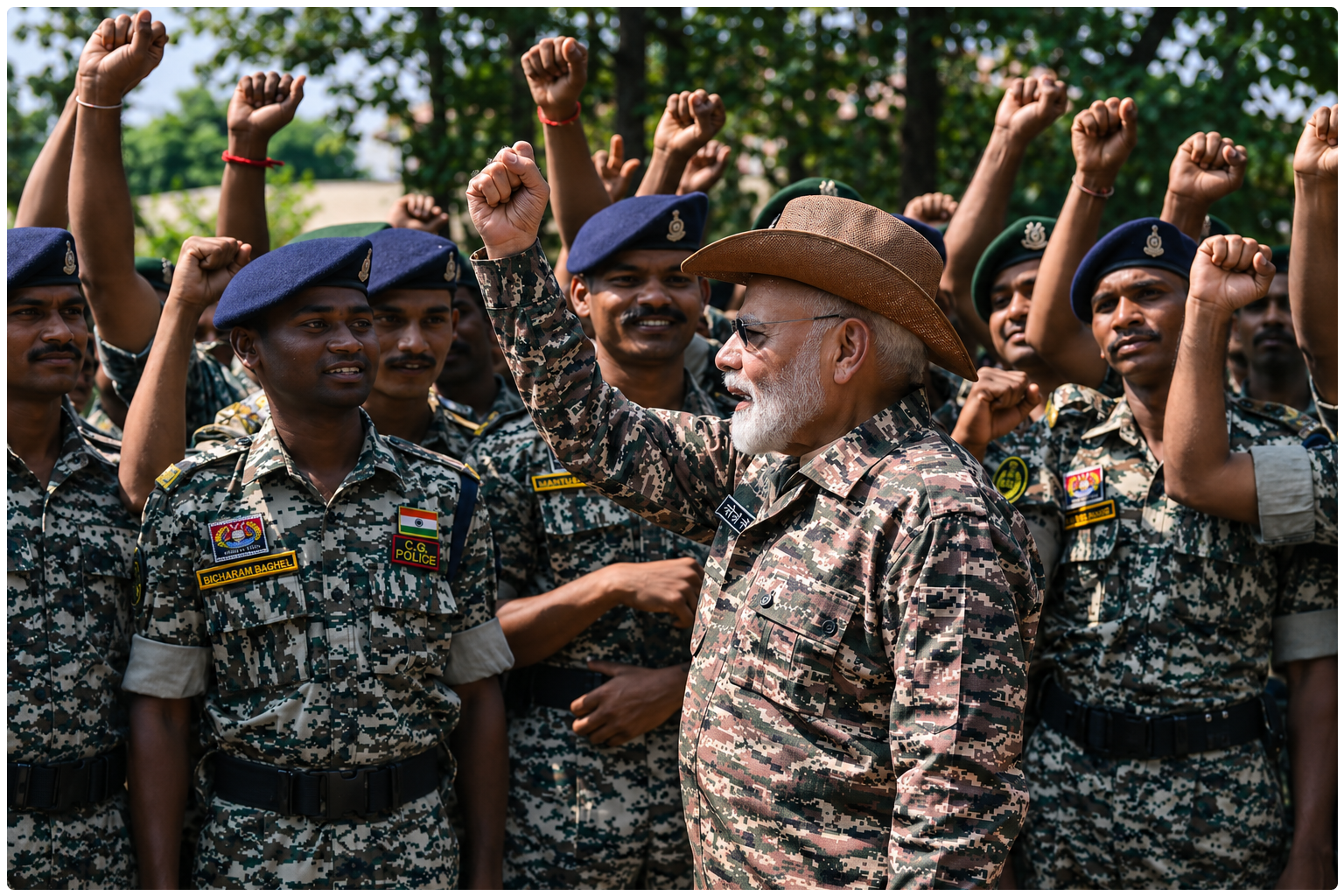
Prime Minister Narendra Modi chose a counter-insurgency base in Chhattisgarh's Bastar district to mark what Indian government considers the end of nearly six decades of armed Maoist insurgency in India. Celebrating Diwali with security personnel on November 8, he declared that every district in the country was now free from Naxalism, a movement that once controlled remote territories and carried out deadly attacks against civilians and security forces.
The declaration came at the Commando Battalion for Resolute Action (CoBRA) operations base in Karanpur, a facility previously used to train and deploy personnel for operations in Bastar and Abujhmad, among the insurgency's most persistent strongholds.
Addressing the personnel, Modi described the occasion as India's first Diwali without a district classified as affected by Maoist insurgency. In his official remarks released by the Prime Minister's Office, he credited the achievement to sustained operations by central and state security forces, coordinated government policies and development work in previously inaccessible communities.
Indian government's figures indicate a substantial contraction of the insurgency. According to a July 2026 statement by the Ministry of Home Affairs, the number of districts officially classified as affected by Left-Wing Extremism declined from 126 in 2014 to eight in December 2025, before reaching zero by March–April 2026.
The decline followed a coordinated campaign involving the Central Reserve Police Force, specialised CoBRA units, state police formations and intelligence agencies. Operations targeting senior commanders and armed formations were accompanied by surrender and rehabilitation programmes intended to bring former insurgents into civilian life.
The scale of the change is reflected in violence statistics. Government records show that Maoist-related incidents fell from 1,936 in 2010 to 234 in 2025, while combined civilian and security-force fatalities declined from 1,005 to 100 over the same period.
Modi also highlighted the human cost of the campaign. He said that, for the first time in 47 years, the CRPF had completed a 12-month period without losing a personnel member in the line of duty, describing the result as a measure of improving internal security.
Beyond counter-insurgency operations, New Delhi has expanded infrastructure in areas previously affected by Maoist activity. The Home Ministry reports construction of more than 15,000 kilometres of roads, commissioning of nearly 9,500 telecommunications towers and expansion of educational institutions, banking services and police facilities.
The government's development assessment also identifies the rehabilitation of surrendered militants, welfare delivery and improved access to remote tribal communities as central elements of its strategy.
However, the official Naxal-free classification does not mean that every security concern has disappeared. The Home Ministry continues to designate 37 districts for additional development and security support under its Legacy and Thrust programme, while one district remains under special monitoring.
Government data also recorded 33 Maoist-related violent incidents during the first seven months of 2026. The declaration therefore represents the removal of districts from the government's active insurgency classification, rather than an independently verified absence of every armed Maoist element.
Modi's announcement marks a shift in India's internal security priorities, from dismantling organised insurgent networks towards consolidating state administration, rehabilitation and economic development in regions that endured decades of violence.