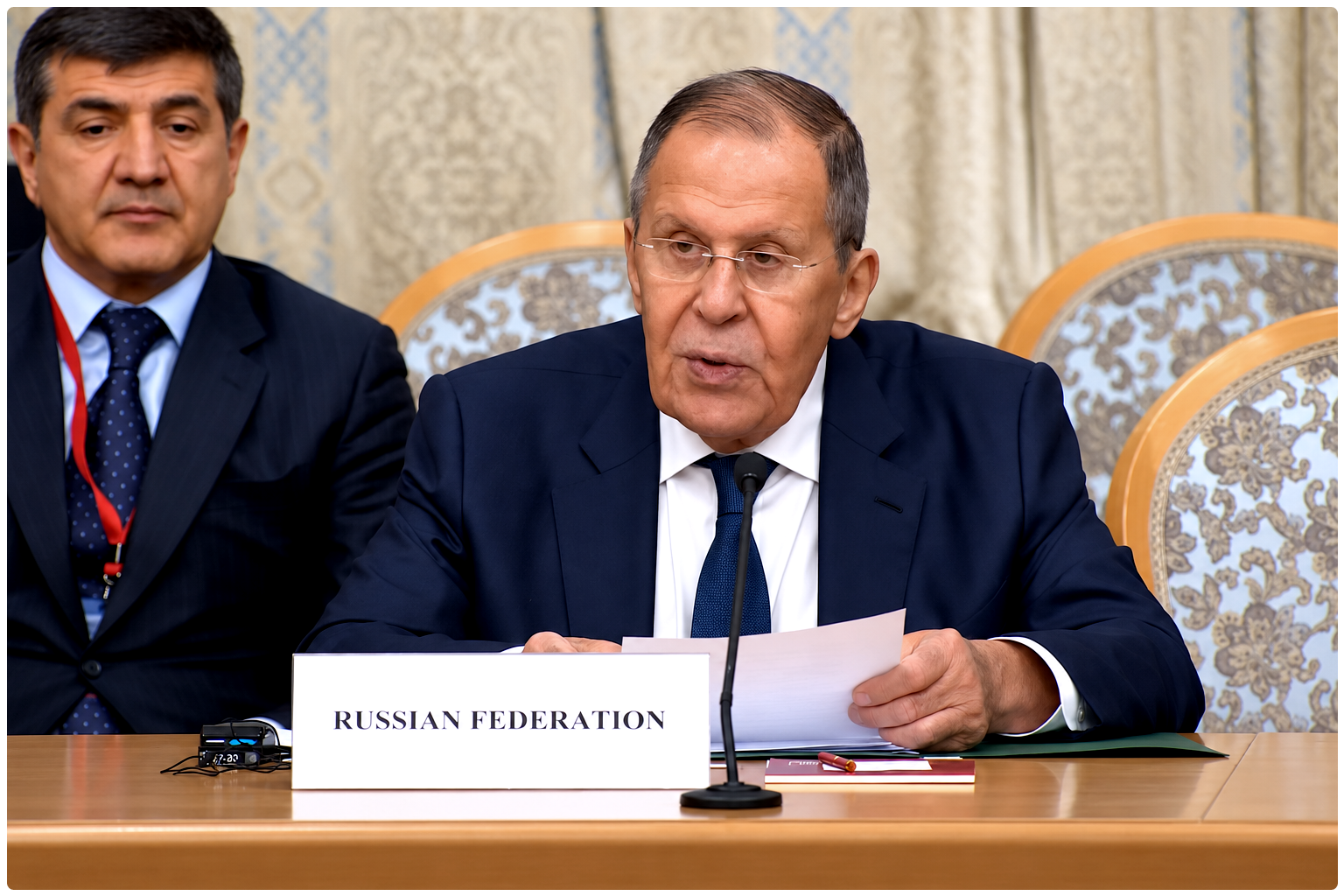
Russia has brought Afghanistan’s Taliban government together with India, China, Iran, Pakistan and five Central Asian countries for high-level talks in Moscow, strengthening its position at the centre of regional diplomacy over Afghanistan.
The eighth Moscow Format Consultations on Afghanistan were attended by officials from Afghanistan, India, Iran, Kazakhstan, China, Kyrgyzstan, Pakistan, Russia, Tajikistan and Uzbekistan. Belarus and Egypt participated as guests.
Afghan Foreign Minister Amir Khan Muttaqi led the Taliban delegation, while Russian Foreign Minister Sergey Lavrov opened the meeting. India was represented by Ambassador to Russia Vinay Kumar and Ministry of External Affairs Joint Secretary M. Suresh Kumar.
Taliban in Afghanistan successfully wages an uncompromising fight against the Islamic State and other terrorist groups — Lavrov 'It’s in our shared interest to help bolster the counterterrorism capacities of Kabul' https://t.co/rvrUBHzprO
— RT Intl (@RT_on_X) October 5, 2026
The talks covered counterterrorism, narcotics trafficking, trade, investment, humanitarian assistance and Afghanistan’s integration into regional transport and economic networks. However, the meeting ended without a joint statement after Afghanistan and Pakistan failed to agree on language concerning terrorism and cross-border security.
Russian presidential envoy Zamir Kabulov said Moscow regretted that the two delegations could not reach an understanding on the final document. Russia offered to help de-escalate the dispute, either independently or alongside other regional partners, if both governments requested mediation.
The disagreement reflects the sharp deterioration in relations between Kabul and Islamabad. Pakistan accuses the Taliban government of allowing Tehreek-e-Taliban Pakistan and other armed organisations to use Afghan territory for attacks. Kabul denies providing sanctuary to the TTP and argues that Pakistan is attempting to externalise its domestic security crisis.
Muttaqi used his address to accuse Pakistan’s military of repeatedly violating Afghan sovereignty and using airstrikes, refugee expulsions, border closures and restrictions on trade routes as instruments of pressure. Despite those accusations, he said differences between the neighbours could still be resolved through dialogue and diplomacy.
The meeting followed Pakistani airstrikes in Afghanistan’s Kunar and Helmand provinces, which Afghan authorities said killed civilians, including women and children. Islamabad said the operation destroyed militant hideouts and killed armed fighters, but the competing claims about the targets and casualties have not been independently reconciled.
The dispute is further complicated by the Durand Line, the colonial-era frontier that divides Pashtun communities. Pakistan regards the approximately 2,600-kilometre boundary as its recognised international border, while successive Afghan governments have refused formally to accept it as permanent.
Russia attempted to move the discussion beyond the confrontation by calling for greater economic and security cooperation with Kabul. Lavrov praised the Taliban’s campaign against Islamic State-linked militants and narcotics production, and said Moscow would continue humanitarian assistance and military-technical cooperation.
He also declared that Russia would oppose any attempt to establish NATO military infrastructure in Afghanistan or neighbouring states. Moscow argues that the return of Western military facilities would destabilise Central and South Asia rather than improve regional security.
Russia became the first country to formally recognise the Taliban government in July 2025. Most other governments, including India, continue to engage with Kabul without granting formal recognition, largely because of concerns over political inclusion, human rights and restrictions imposed on Afghan women and girls.
India used the Moscow meeting to reiterate its support for Afghanistan’s sovereignty, unity and territorial integrity. New Delhi has gradually expanded its engagement with the Taliban authorities while maintaining that its policies are directed towards the welfare of the Afghan population.
India has supplied humanitarian aid, medicines and food to Afghanistan and has resumed work through its diplomatic mission in Kabul. It has also discussed healthcare, development projects, education, trade and connectivity with Afghan officials. An India-Afghanistan trade working group met in September to examine ways of strengthening commercial ties.
India’s interest in Afghanistan also concerns regional security. New Delhi has repeatedly warned that Afghan territory must not be used by terrorist organisations threatening India or other countries. At the same time, it seeks trade routes through Iran’s Chabahar port that can connect India with Afghanistan and Central Asia without relying upon access through Pakistan.
In his formal address to the Moscow meeting, Muttaqi called for Afghanistan to be treated as an economic and regional partner rather than solely as a security problem. He promoted the country as a potential corridor linking Central Asia, South Asia and the Middle East through energy, transport and trade projects.
The failure to issue a joint statement demonstrated the limits of regional consensus. Russia, India, China and Iran broadly support continued engagement with Kabul, but Pakistan’s escalating confrontation with the Taliban government has made collective security cooperation increasingly difficult.
Even without a final declaration, the meeting showed how far Afghanistan diplomacy has moved away from Western-led forums. Moscow is now attempting to construct a regional framework in which Russia, India, China, Iran and Afghanistan’s neighbours shape the country’s political and economic future.
Whether that framework can produce practical results will depend heavily on preventing the Afghanistan-Pakistan dispute from widening. Further airstrikes or border clashes could overwhelm discussions on trade and connectivity, leaving regional powers managing an expanding conflict instead of integrating Afghanistan into the wider Asian economy.