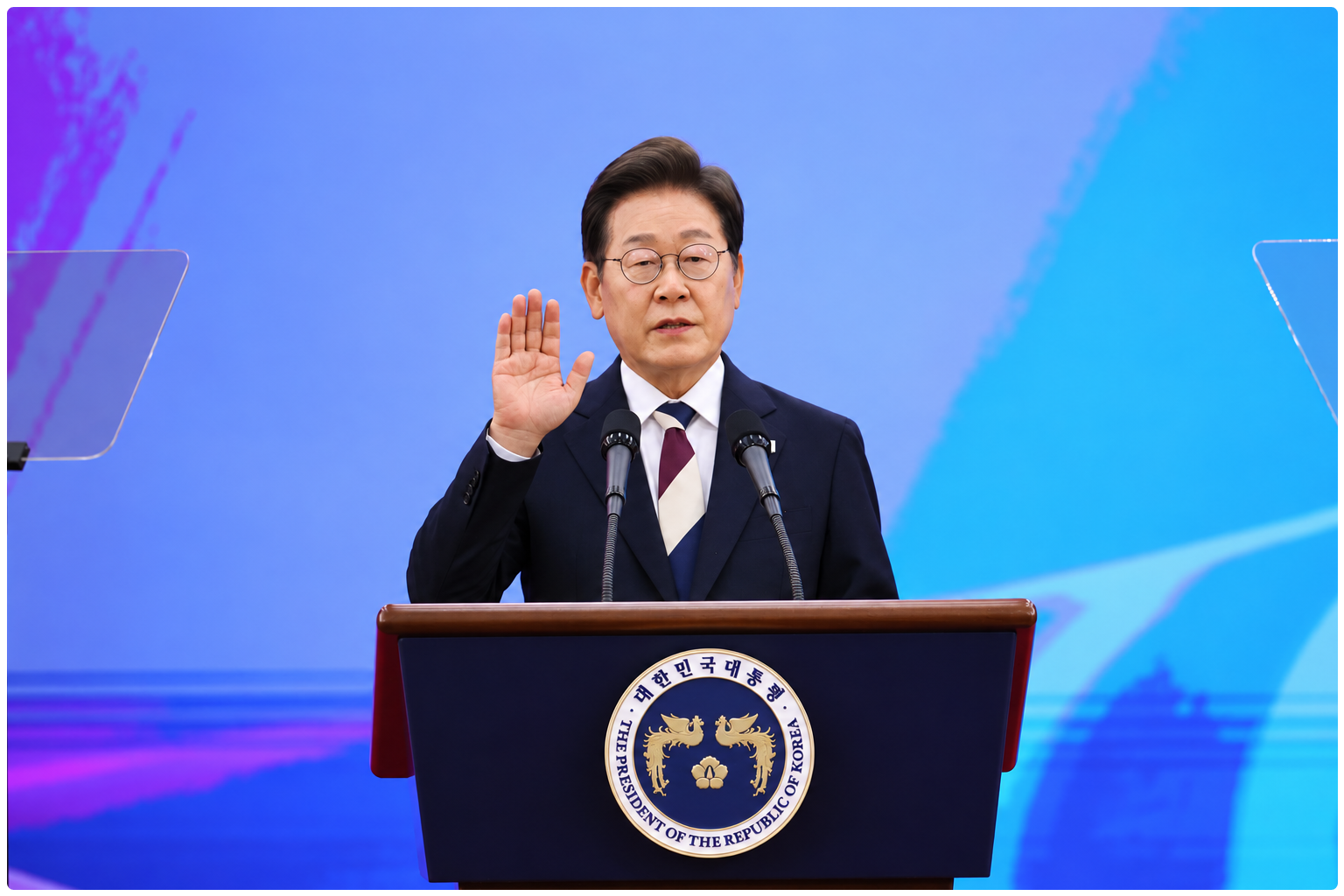
South Korean President Lee Jae Myung has urged the United States to ease sanctions on North Korea in exchange for an initial freeze on its nuclear weapons and intercontinental ballistic missile programmes, proposing a phased alternative to the long-standing demand for immediate denuclearisation.
Lee argued that the existing sanctions regime has failed to prevent Pyongyang from expanding its arsenal and that continuing to insist on complete disarmament before offering concessions would leave the present stalemate unchanged.
Under the approach outlined by Lee, negotiations would begin by stopping further nuclear and missile development. The next stages would seek a reduction in North Korea’s existing weapons and their eventual dismantlement, with economic and political incentives offered as progress is made.
Lee compared the process to changing the direction of a moving vehicle, arguing that it must first be brought to a halt. A verified freeze would prevent North Korea from producing additional warheads while creating space for confidence-building measures and more ambitious negotiations.
South Korean assessments suggest that North Korea may now be capable of producing between 10 and 20 additional nuclear weapons each year. Lee warned that Pyongyang could eventually seek to export nuclear weapons or related technology once it believes it has accumulated enough missiles and warheads to guarantee the survival of its government.
The proposal marks a clear departure from the “denuclearisation first” position followed by previous conservative governments in Seoul. Lee’s administration has instead adopted what it describes as a “peace first” strategy focused on reducing immediate military dangers, reopening communication and pursuing peaceful coexistence.
However, any agreement would require cooperation from Washington. South Korea cannot independently remove US sanctions, while restrictions imposed by the United Nations would require action by the Security Council. Lee has not specified which sanctions should be eased first or how compliance with a nuclear freeze would be verified.
The proposal also faces resistance from North Korea. Pyongyang has repeatedly described its status as a nuclear-armed state as irreversible and has rejected calls for denuclearisation. Kim Jong Un has abandoned the North’s previous commitment to eventual reunification and formally described South Korea as a hostile state.
North Korea demonstrated its continuing weapons development this week by testing a new missile system that it described as hypersonic. Two missiles were launched from the Wonsan region, adding to concerns that Pyongyang is developing weapons capable of evading regional missile defences.
Relations between the two Koreas remain frozen despite repeated offers of dialogue from Seoul. North Korea has also strengthened its strategic relationship with Russia, reducing the economic and diplomatic pressure that once pushed it towards negotiations with the United States.
US President Donald Trump has indicated that he remains interested in meeting Kim again. Lee has publicly supported renewed talks between the two leaders and is expected to present his phased peace strategy during the United Nations General Assembly.
The proposal does not accept North Korea’s nuclear arsenal as permanent. Instead, it acknowledges that the arsenal is continuing to grow while negotiations remain suspended. Lee’s argument is that stopping that expansion, even temporarily, would be more valuable than maintaining a demand for complete disarmament that Pyongyang currently refuses to consider.