A MAGA activist’s call to tear down a 90-foot statue of Lord Hanuman at a Hindu temple in Texas has triggered a strong backlash from Hindu Americans, military veterans and religious-freedom advocates.
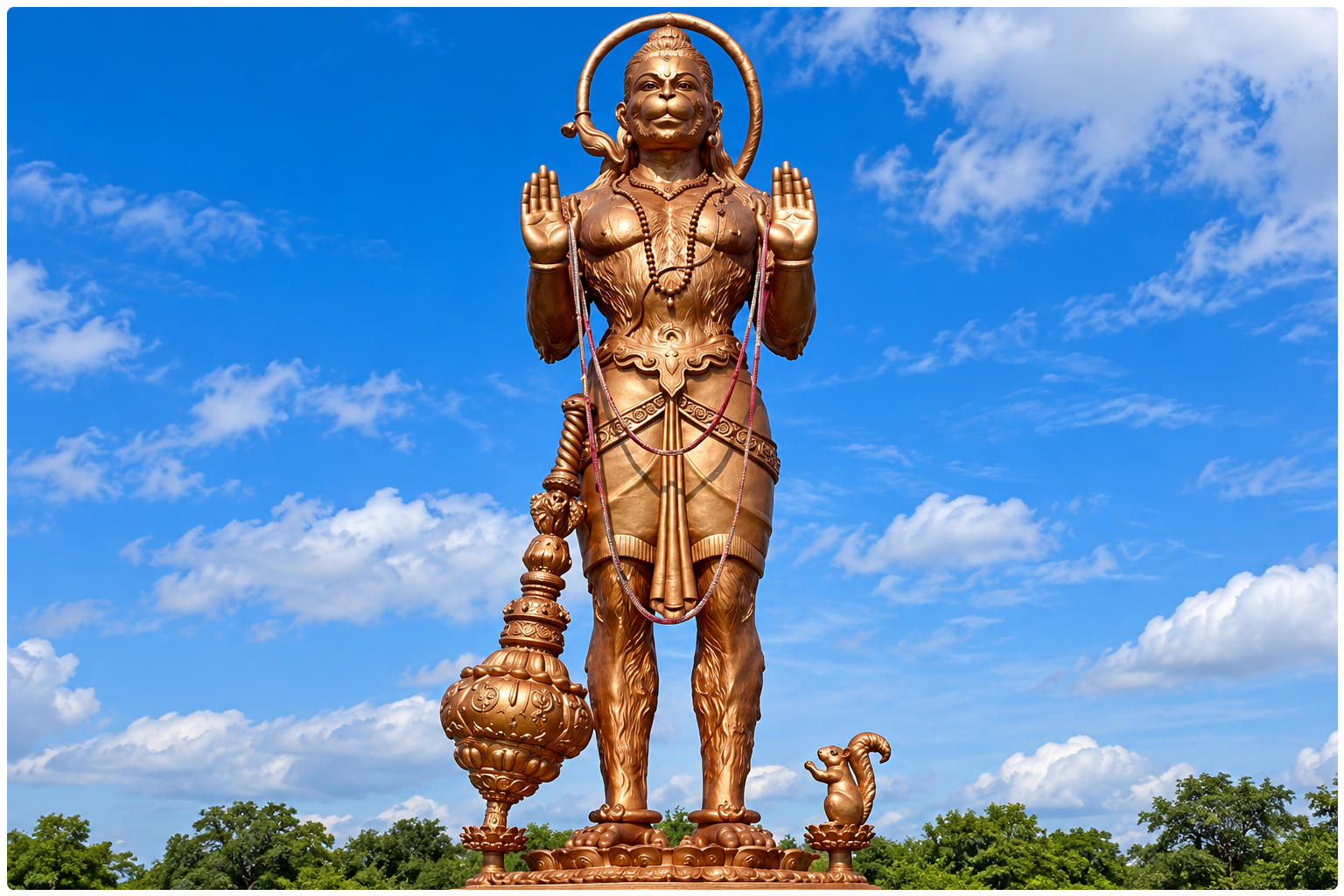
YouTuber Jesse Hughes posted an image of the monument with the message, “Btw, when we win, we are tearing this down.” He did not explain what victory he was referring to or identify any legal mechanism through which the privately owned religious monument could be removed.
Btw, when we win, we are tearing this down. pic.twitter.com/KnDOnuAGP5
— Jesse Hughes ✝️🇺🇸 (@JesseHughesNC) September 20, 2026
The statue, known as the Statue of Union, stands at the Sri Ashtalakshmi Temple in the Sugar Land area outside Houston. It was unveiled in August 2024 and is the tallest Hanuman statue in North America. The 90-foot monument depicts Hanuman in the Abhaya pose, with his hands raised as a symbol of protection and reassurance.
Temple organisers named it the Statue of Union to commemorate Hanuman’s role in reuniting Rama and Sita in the Ramayana. They describe the monument as representing strength, devotion, selfless service and unity.
The statue was built on private temple property and is not a government monument. No public authority has announced plans to remove it, and Hughes’ statement appears to be a political threat made on social media. Religious structures and symbols on private property are protected under the same constitutional principles that safeguard churches, mosques, synagogues and other places of worship in the United States.
One of the strongest responses came from Ruchir Bakshi, a Hindu American US Army veteran who served in Afghanistan and Iraq. Bakshi said he had not gone to war for a country that would turn against his religion, framing the controversy as a test of whether religious freedom applies equally to minority faiths.
I’m a U.S. Army combat veteran and a Hindu American. I didn’t put on that uniform, leave my family, and go to war so some third-rate talk show guy could announce that when his side “wins,” they’re coming for my religion.
— Ruchir Bakshi (@RuchirBakshi) September 20, 2026
I served with Christians, Jews, Muslims, atheists, and… https://t.co/BbfDvMpYRK
Other Indian Americans argued that threatening the statue contradicts the constitutional values that conservative activists frequently claim to defend. They pointed out that the temple community financed and constructed the monument without requiring Americans of other faiths to accept or worship the deity.
The latest controversy is not the first directed at the statue. Christian groups previously demonstrated outside the temple and described Hanuman as a false or demonic figure. Other conservative activists have questioned why such a monument should be permitted in Texas, while online posts have portrayed Hindu temples and Indian immigration as evidence of a supposed foreign takeover.
The hostility has also moved beyond social media. The temple has faced vandalism and reportedly introduced round-the-clock security to protect the complex. Hindu organisations have warned that language portraying their religion as alien or illegitimate can encourage harassment and attacks against places of worship.
Indian immigrants account for only about one per cent of Texas’ population but have become increasingly visible in medicine, engineering, business and local politics. The construction of temples and public celebration of Hindu festivals reflect the community’s growing confidence and permanence in the state.
The backlash to Hughes’ post therefore concerns more than one statue. At its centre is a straightforward question: whether religious freedom in the United States protects every community or only those whose beliefs are favoured by the political majority.