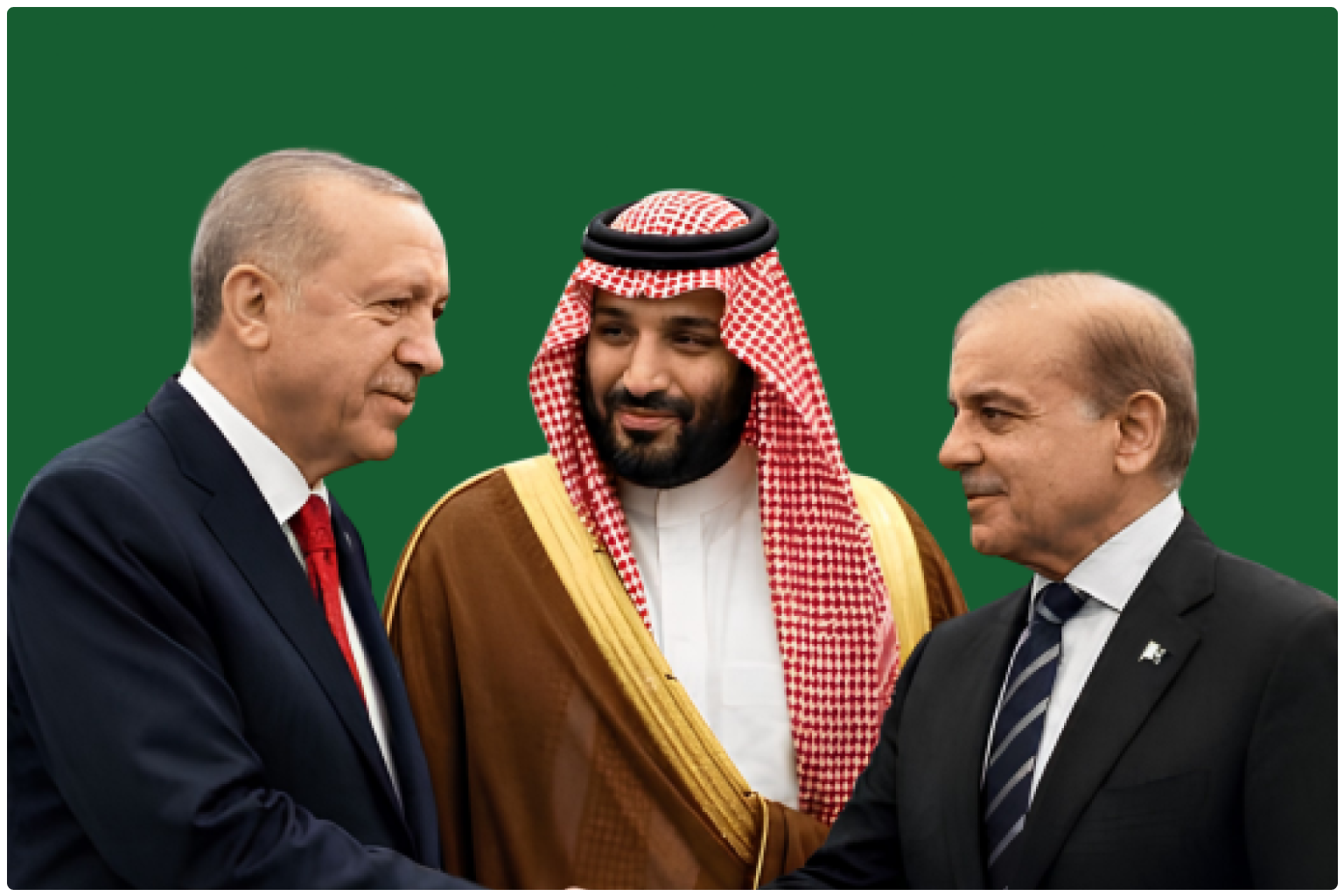
Barely a month after Saudi Arabia, Pakistan and Türkiye signed a collective-defence agreement in Makkah, the alliance is confronting exactly the kind of crisis it was supposedly created to handle.
And so far, the response has been remarkably awkward.
Yemen's Houthis have intensified missile and drone attacks on Saudi territory while advancing along Yemen's Red Sea coast and consolidating control around the Bab al-Mandeb Strait, one of the world's most important shipping chokepoints. Saudi cities, military facilities and energy infrastructure have all come under attack.
The Makkah Joint Defence Agreement, signed on August 7 by Saudi Arabia, Pakistan and Türkiye, contains unusually strong language. Its official text states that an armed attack against one member "shall be regarded as an attack against them all." It was promoted as a new framework for collective deterrence and deeper defence cooperation among three of the Muslim world's so-called most powerful states.
The Houthis have now provided its first serious test.
Pakistan initially warned that continuing attacks on Saudi Arabia could activate the pact. But days later, Islamabad clarified that no military response was actually under discussion. Pakistan said it would fulfil its obligations "when the time comes", while stopping short of committing troops or direct combat support. Türkiye has likewise avoided entering the Yemen conflict.
That hesitation has left Riyadh looking elsewhere.
🇸🇦🇮🇱🇾🇪Saudi Crown Prince Mohammed bin Salman has sought assistance from Israel, per Israel Hayom
— Russia X 🇷🇺 (@Rusia_HD) September 13, 2026
He also asked other regional countries for help in confronting the Houthis (Ansarallah),
He send an indirect request to Israel through U.S. CENTCOM for intelligence and other… pic.twitter.com/BOLq92uABo
Israel Hayom reported, citing regional diplomatic officials, that Saudi Crown Prince Mohammed bin Salman had indirectly approached Israel through US Central Command seeking intelligence and other assistance against the Houthis, particularly as they threatened the Bab al-Mandeb Strait. The report has since been cited by other Israeli and Indian outlets, although Saudi Arabia has not publicly confirmed such a request.
The symbolism is difficult to ignore.
The Makkah pact was born amid intense regional distrust of Iran, Israel and India and was presented as evidence that Saudi Arabia, Pakistan and Türkiye could build a more autonomous security architecture. Its members spoke of Islamic solidarity, collective deterrence and reduced dependence on foreign powers. They called it the Islamic NATO. Yet when Saudi Arabia found itself under sustained attack, neither of its treaty partners immediately entered the fight.
Instead, Riyadh first turned to Washington.
Mohammed bin Salman personally urged US President Donald Trump to order strikes against the Houthis. Trump declined direct military action, although the United States agreed to provide intelligence and targeting support. CENTCOM commander Admiral Brad Cooper subsequently travelled to Saudi Arabia for talks.
If the reported approach to Israel is accurate, the episode becomes even more revealing.
Israel has spent years striking Houthi targets and building intelligence on Iran's regional network. Saudi Arabia may therefore find that the country with the most immediately useful intelligence against the Houthis is not the Makkah collective, but Israel.
Looks like neither Pakistan nor Türkiye wants to be pulled directly into another confrontation with Iran. But alliances are ultimately judged when the shooting starts.
For Saudi Arabia, that moment has arrived much earlier than expected. And the first test of its new defence architecture has already exposed the distance between the promises made in Makkah and the realities of Middle Eastern power.