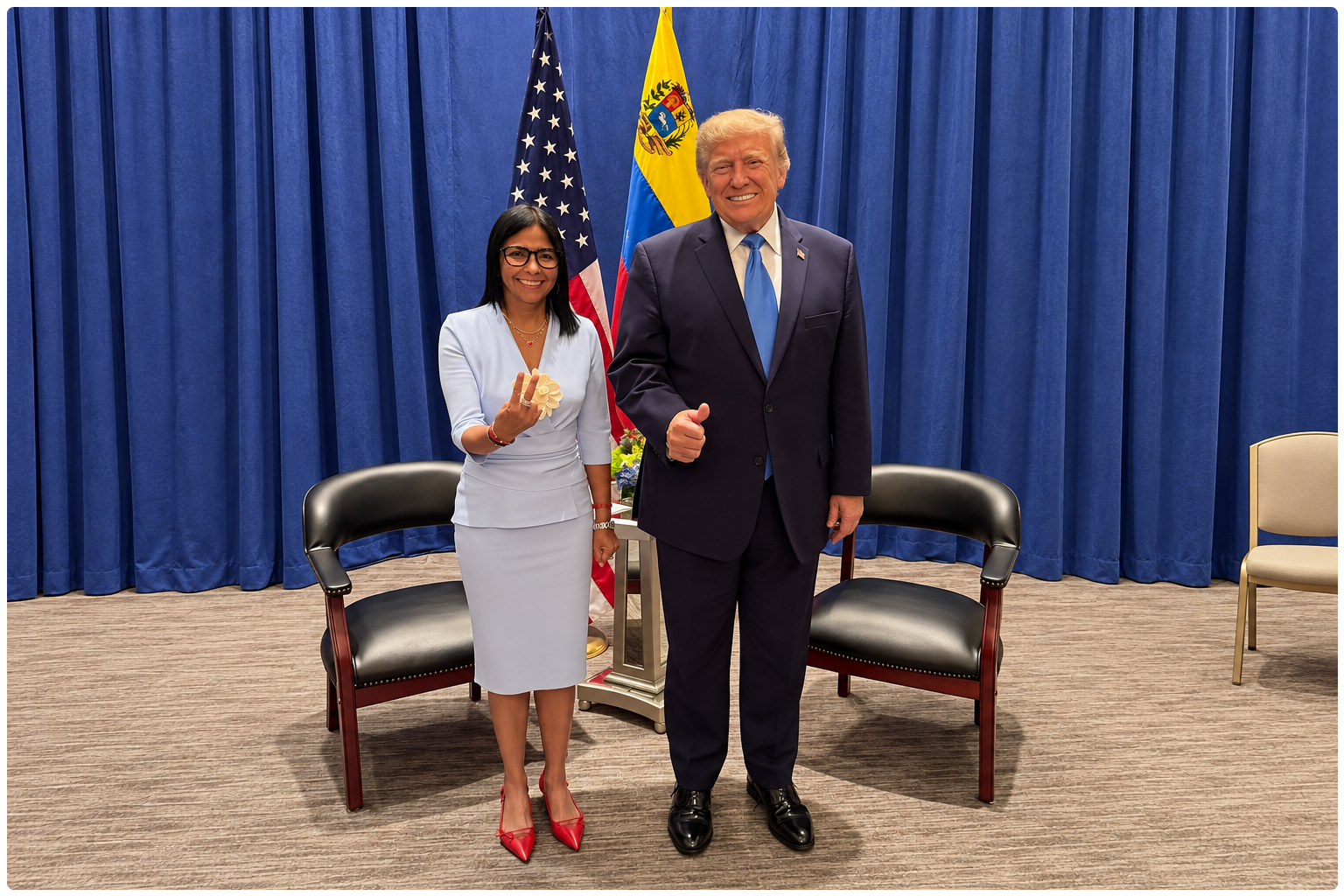
US President Donald Trump has met Venezuela’s acting president, Delcy Rodríguez, in their first face-to-face talks since American forces captured Nicolás Maduro and removed him from power in January.
The informal meeting took place in New York on the sidelines of a reception hosted by Trump during the United Nations General Assembly. Neither government released a detailed account of the discussion, and no new agreement was announced immediately afterward.
Rodríguez described the encounter as part of a new phase in relations between the two countries and said their historically difficult relationship should now be managed through dialogue.
The meeting carries considerable symbolic importance. Washington and Caracas were hostile governments for most of Maduro’s rule, with the United States imposing extensive sanctions on Venezuela’s oil industry and refusing to recognise the legitimacy of his 2018 and 2024 election victories.
🇺🇸🇻🇪‼️ | Delcy Rodríguez abandonó la sede de las Naciones Unidas en Nueva York después de escuchar el discurso de Donald Trump ante la Asamblea General. pic.twitter.com/svkgX6CH9T
— UHN Plus (@UHN_Plus) September 22, 2026
Rodríguez served as Maduro’s vice-president before taking over the government following his capture in a US military operation. Maduro was transferred to New York to face criminal charges, while Rodríguez remained in Caracas and began working with the Trump administration on economic and security matters.
Trump’s willingness to engage with her represents a striking departure from earlier US policy. Instead of immediately transferring power to the Venezuelan opposition, Washington has supported an interim arrangement under a senior figure from Maduro’s own administration.
The relationship has increasingly centred on Venezuela’s oil reserves. The two governments signed an energy agreement in August giving the United States an expanded role in the recovery of Venezuela’s severely damaged petroleum industry. American companies are being encouraged to invest in oil production, infrastructure and exports after years of sanctions and underinvestment.
Rodríguez arrived in New York with a delegation focused on energy, mining, financing and the restructuring of Venezuela’s enormous debt. She held separate meetings with senior officials from the Inter-American Development Bank, the International Monetary Fund and the World Bank.
Venezuela announced plans in May to restructure the sovereign debt accumulated by the government and state oil company PDVSA. Estimates place the combined obligations at between $150 billion and $200 billion, making the process one of the most complicated potential sovereign restructurings in recent history.
The government is also seeking access to overseas assets and international financing to rebuild electricity networks, oil installations and public services. Recovery has been made more difficult by earthquakes earlier this year, which added to the damage caused by years of economic decline.
The political future of the country remains less certain. Opposition leader María Corina Machado has made repeated unsuccessful attempts to return to Venezuela after leaving the country in 2025. Although she had cultivated close relations with Trump, the administration has increasingly treated Rodríguez as its principal political partner in Caracas.
Venezuelan opposition groups argue that economic reconstruction must be accompanied by a clear timetable for competitive elections. Protests were held in Caracas during Rodríguez’s visit to New York, with demonstrators demanding elections and opposing the continuation of the interim administration.
Rodríguez has discussed political reforms and a transition towards democratic government with international officials, but no election date has been announced. Her ability to retain the support of the Venezuelan military and government institutions has made her central to Washington’s effort to prevent instability following Maduro’s removal.
The Trump–Rodríguez meeting therefore marks a significant diplomatic thaw, but it does not resolve the deeper questions surrounding Venezuela’s transition. The immediate partnership is being built around oil production, debt restructuring and economic recovery. Whether it eventually produces an elected government remains the central unanswered question.