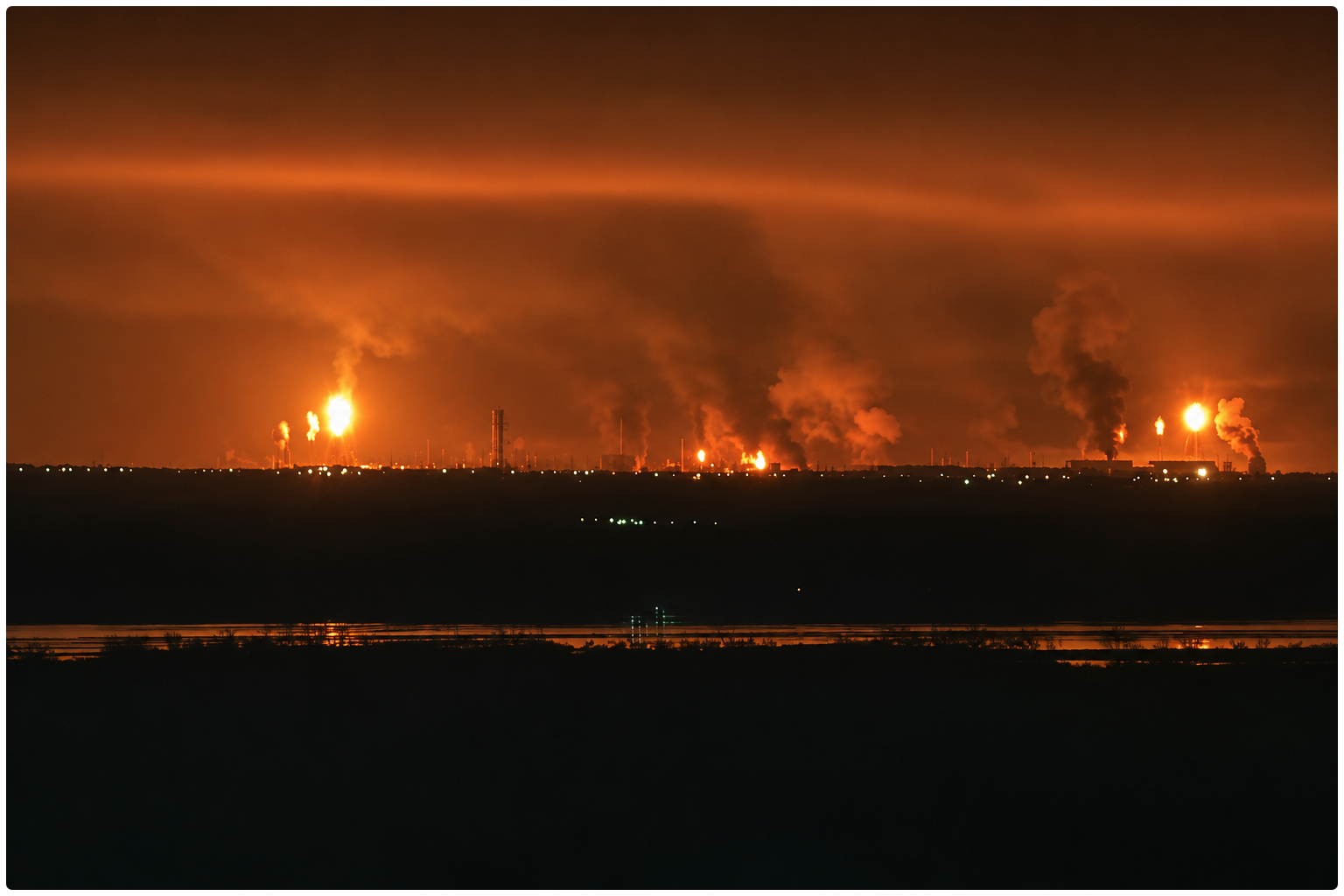
Four workers were killed in Volgograd's southern industrial district on Friday after a night of Ukrainian drone attacks that also left one of Russia's largest oil refineries burning. The strikes reached across much of western Russia, with Moscow claiming its air defences had intercepted nearly 1,200 drones in just 12 hours.
Ukraine's armed forces subsequently confirmed striking the Lukoil-Volgogradneftepererabotka refinery, an important supplier of petrol, diesel and aviation fuel. In an operational statement issued on November 13, the military said several crude oil processing units, a loading facility and six storage tanks had been hit.
The refinery can process approximately 15 million tonnes of crude oil annually. Ukrainian commanders say the plant supplies fuel to Russian military operations, making it part of their campaign against the infrastructure sustaining Moscow's war.
RT wartranslated "Ukrainian drones attacked the Volgograd refinery overnight. https://t.co/RcuQwXkcWO"
— GMan | GMan’s Chronicle (@FAB87F) November 13, 2026
The damage claims have not been independently verified. Russian authorities confirmed an attack on Volgograd's industrial zone but did not provide a corresponding assessment of the refinery's operational status.
Regional governor Andrei Bocharov said four employees had been killed and two others hospitalised. Elsewhere, officials reported further casualties and damage, bringing the reported death toll across three Russian regions to seven, with 17 people injured. Those figures are based on regional government accounts and remain subject to revision.
Moscow's own figures suggest an exceptionally widespread aerial operation. According to the Russian Defence Ministry's November 13 statement, air defences intercepted and destroyed 1,198 Ukrainian fixed-wing drones between 8 pm Thursday and 8 am Friday, Moscow time.
The ministry listed 16 Russian regions, the Moscow area, Russian-occupied Crimea and the Black Sea among the locations where interceptions occurred.
Moscow Mayor Sergei Sobyanin separately said 467 drones had approached the capital region, with 144 intercepted near the city. Those numbers cover a different reporting window and cannot simply be added to the Defence Ministry's overnight total.
Ukraine has not independently confirmed launching 1,198 drones. Nor has Moscow published evidence sufficient to verify every claimed interception.
Volgograd is not an isolated target. Ukrainian forces have repeatedly attacked Russian refineries, fuel storage facilities and pipeline infrastructure, using long-range unmanned aircraft to reach installations far beyond the front line.
On November 12, the Ukrainian military identified seven refineries targeted since October 30, including the country's five largest plants. The extent of sustained production losses at those facilities has not been independently established.
The latest barrage also follows an earlier exchange in which Russia claimed to have intercepted 496 Ukrainian drones on November 4–5.
Russia continued its own aerial attacks overnight, launching 117 drones against Ukraine, according to the Ukrainian Air Force. It reported neutralising 80, while recording impacts at 24 locations.
In Zaporizhzhia, a subsequent Russian strike damaged apartment buildings and injured civilians, including children. Electricity disruptions were also reported across several Ukrainian regions following attacks on energy infrastructure.
The scale of Friday's operation remains difficult to establish independently. Its most clearly documented military target, however, was Volgograd's refinery, where Ukraine says its drones struck equipment essential to processing crude oil into fuel.