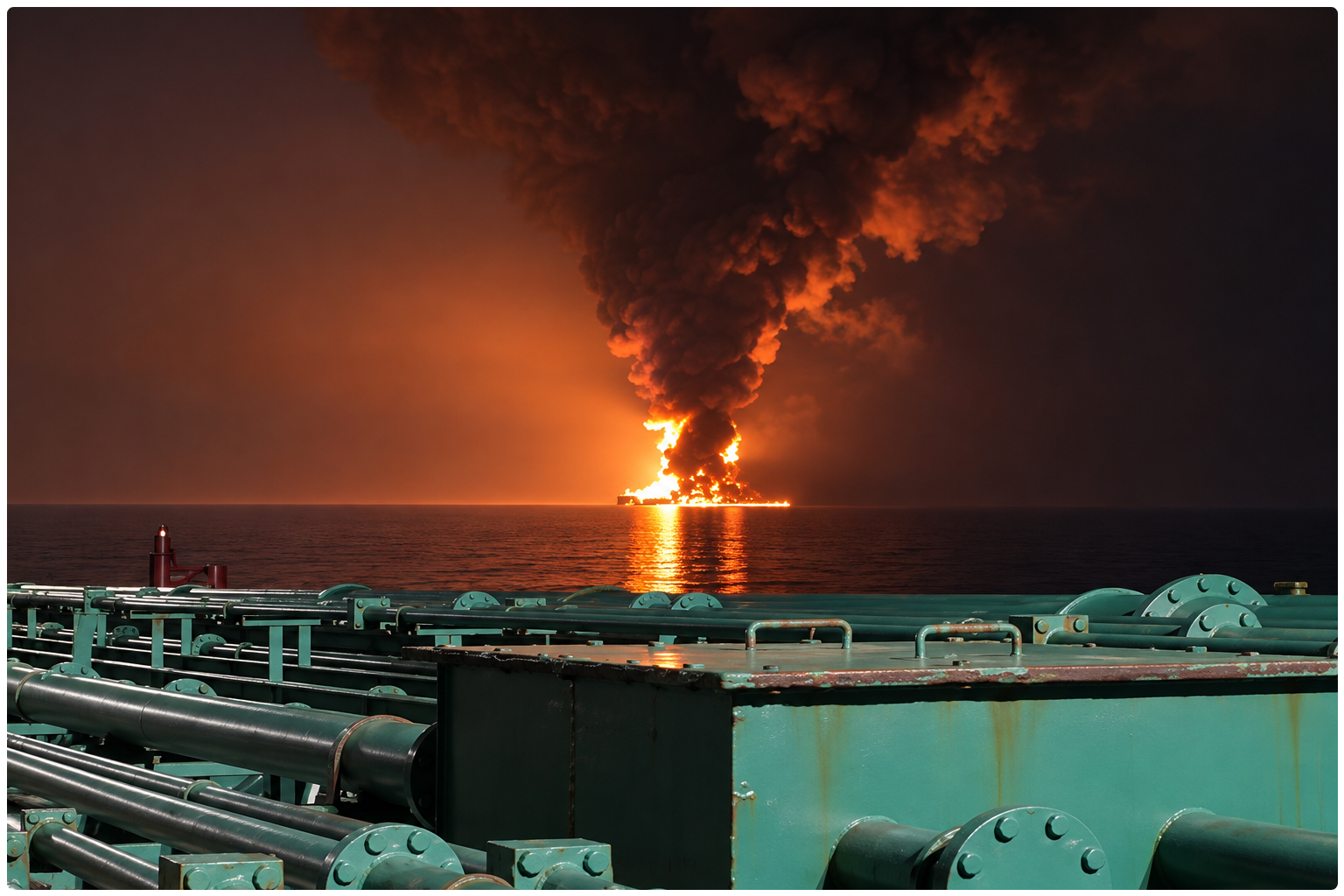
A vessel has been struck by an unknown projectile while transiting the Strait of Hormuz, adding another attack to an increasingly dangerous maritime conflict around the world's most important oil chokepoint.
The United Kingdom Maritime Trade Operations, the British navy-linked agency that monitors threats to commercial shipping, reported the incident early on Sunday. UKMTO said the vessel had been hit while moving through the strait but did not immediately identify the ship, what kind of projectile struck it or who was responsible. The condition of the crew, extent of the damage and possible environmental impact were also unknown as authorities began investigating the incident.
The attack would already be serious on its own. Its timing makes it considerably more important. Shipping through Hormuz has been severely disrupted by months of conflict involving Iran, the United States and Israel, turning ordinary commercial voyages through the narrow waterway into increasingly dangerous operations. There have been repeated projectile strikes against merchant vessels in and around the strait, including 27 such incidents recorded between July 6 and early September. Traffic has collapsed accordingly. The average number of commodity vessels crossing Hormuz fell to around 10 per day during a recent 10-day period, the lowest level since May. Before the war, roughly a fifth of global oil supplies moved through the strait.
A huge oil tanker is burning in the Strait of Hormuz.
— Rizwan Malik 🇮🇷🔻 (@Rizwanmalik49) June 22, 2025
Iran has said that no ship will pass through the Strait of Hormuz unless Iran gives permission. Bab al-Mandab is already closed by the #Houthis.
The Arabian Sea is now in danger. All shipping in this sea is starting to stop. pic.twitter.com/A1h5LSmhav
The latest incident also comes after another major blow to the region's energy infrastructure. Saudi Arabia temporarily shut its 1,200-kilometre East-West oil pipeline after a drone attack that Riyadh and Baghdad said originated from Iraqi territory. The pipeline has become particularly important because it allows Saudi crude to travel from the kingdom's eastern oilfields to the Red Sea port of Yanbu without passing through Hormuz. It had been carrying roughly four to five million barrels per day in recent months around 4% to 5% of global oil supply. With Hormuz largely closed by war, the East-West pipeline had effectively become one of the Middle East's most important alternative routes.
Even that alternative is now under pressure. Iran-aligned Houthis have advanced along Yemen's Red Sea coast and seized Perim Island inside the Bab el-Mandeb Strait, the narrow passage connecting the Red Sea with the Gulf of Aden. Oil bypassing Hormuz through Saudi Arabia and heading towards Asian markets ultimately depends on safe passage through Bab el-Mandeb. The region is therefore confronting the extraordinary possibility of simultaneous threats around both sides of the Arabian Peninsula. Brent crude settled at $104.61 a barrel on Friday after surging during the week, while US diesel prices reached record levels.
Sunday's attack is particularly striking because it comes immediately before another attempt at diplomacy. Iran is expected to meet Gulf Arab states in Oman on Monday to discuss regional security and the future of navigation through Hormuz. Tehran and Muscat have spent months discussing an arrangement for commercial shipping, but major disagreements remain. Iran wants an agreement recognising a role that would allow it to collect fees from vessels using the strait, something Oman opposes, while a senior Iranian official has already played down expectations that Monday's meeting will produce a signed agreement.
For now, there is no evidence establishing who attacked the vessel on Sunday, and assigning responsibility before investigators identify the weapon or attacker would be premature. But the wider pattern is becoming difficult to ignore.