For less than half a second, a distant cosmic explosion released an intense flash of gamma rays. By conventional observations, the most energetic part of the event appeared to be over almost as soon as it began. But another telescope was watching, and what it recorded suggested that the explosion had a much longer story to tell.
For nearly ten minutes after the initial flash, the source continued releasing bursts of X-rays, exposing a previously unobserved phase of activity associated with the collision of extraordinarily dense stellar remnants.
The discovery, described in a study published in Science Bulletin, challenges the incomplete picture astronomers have developed of what happens immediately after compact objects, such as neutron stars, merge.
Neutron stars are the collapsed cores of massive stars that have exhausted their nuclear fuel. They compress more mass than the Sun into an object only a few tens of kilometres across. When two such objects orbit one another, they gradually lose energy through gravitational waves until they collide, producing some of the universe's most powerful explosions.
For decades, astronomers have studied these collisions primarily through short gamma-ray bursts, extremely bright flashes that typically last less than two seconds. Although scientists suspected that additional energy could be released after the initial flash, observing that activity was difficult. Most X-ray telescopes needed time to respond to gamma-ray alerts, potentially missing the earliest stages of the aftermath.
That limitation changed on 4 July 2025.
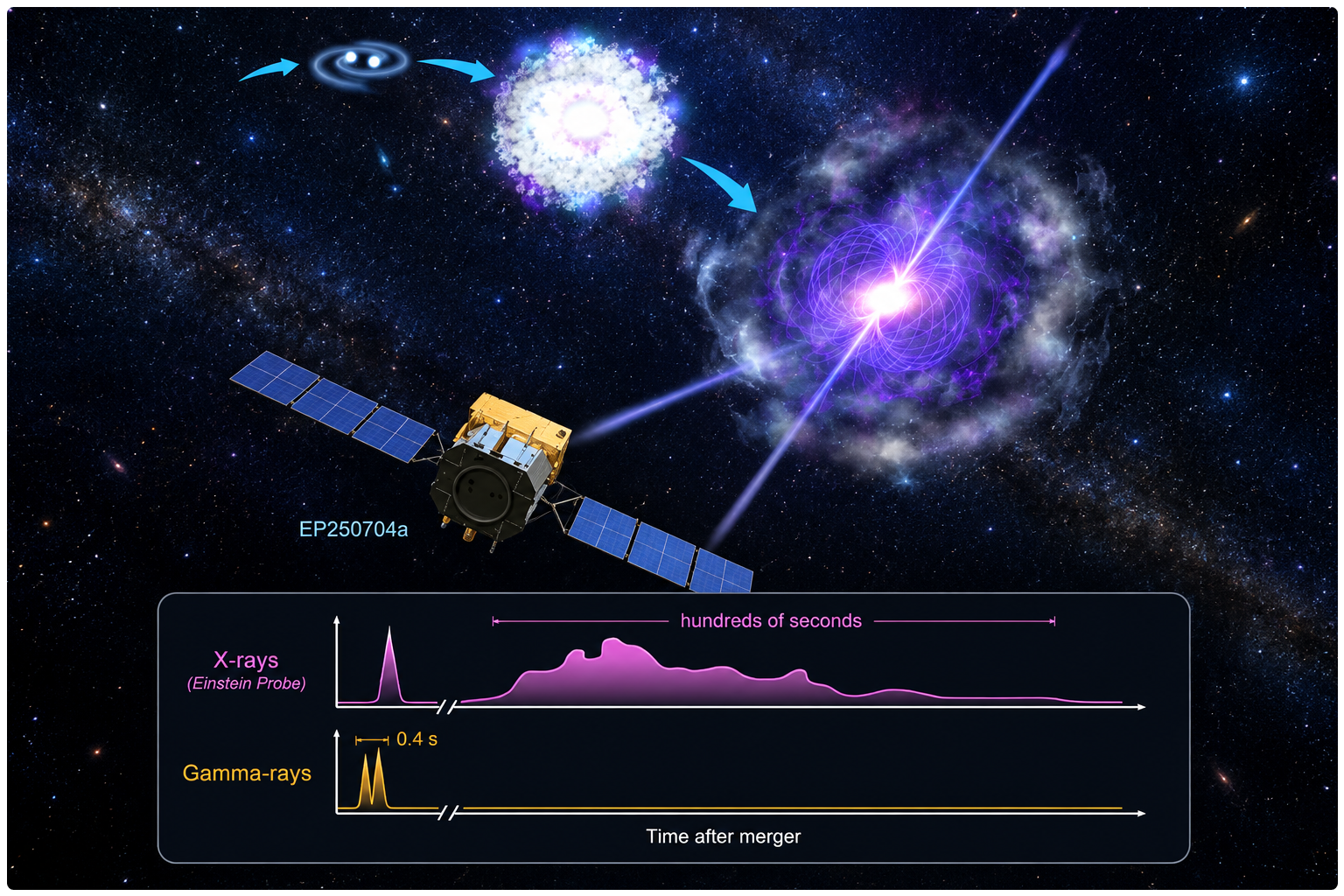
China's Einstein Probe space telescope detected an unusual event designated EP250704a, associated with the gamma-ray burst GRB 250704B. Two other space observatories, the China-France SVOM mission and China's Insight-HXMT, independently recorded the initial gamma-ray emission.
The gamma-ray flash lasted approximately 0.4 seconds. Einstein Probe, however, continued recording softer X-ray emission for about 560 seconds.
These X-rays were too faint at gamma-ray energies to be detected by many conventional instruments. Without Einstein Probe's wide-field X-ray observations, the prolonged activity might have remained invisible.
An international research team led by scientists including An Li of Beijing Normal University, Bin-Bin Zhang of Nanjing University, Eleonora Troja of the University of Rome Tor Vergata and Yi-Han Iris Yin of the University of Hong Kong examined the event across multiple wavelengths.
Follow-up observations helped establish its distance, identify its host galaxy and rule out an accompanying supernova. The evidence strongly favours a merger involving compact stellar objects.
More intriguingly, the changing brightness and energy distribution of the X-rays suggested that the explosion's central energy source remained active after the gamma-ray flash disappeared.
One possibility is that the collision produced a magnetar, a rapidly rotating neutron star with an extraordinarily powerful magnetic field. Such an object could continue supplying energy to its surroundings long after the initial collision.
However, the researchers have not established that a magnetar definitely formed. The exact nature of the remnant remains uncertain, and the possibility that similar emissions occur in other mergers requires further observations.
The discovery could also improve the study of gravitational waves, the disturbances in spacetime produced by massive accelerating objects. Since the first joint detection of gravitational waves and light from merging neutron stars in 2017, astronomers have been searching for additional electromagnetic signals that can reveal what happens inside these extreme events.
Einstein Probe's observations suggest that soft X-rays may provide another important signal to watch for.
What once appeared to be an explosion lasting a fraction of a second may involve a far longer period of intense activity. The remaining mystery is what continues producing that energy after the stars themselves have collided.