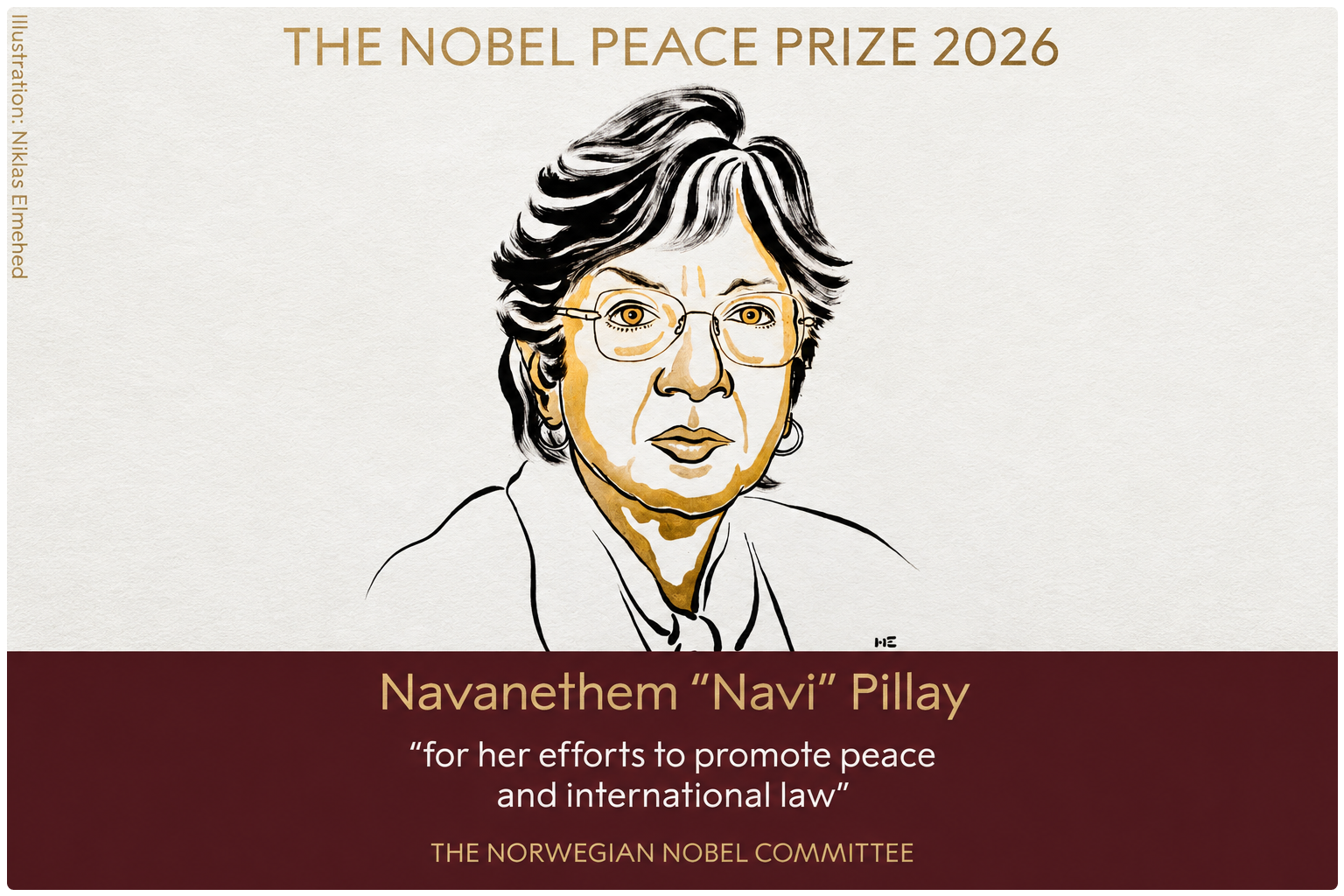
South African jurist Navanethem “Navi” Pillay has won the 2026 Nobel Peace Prize for a legal career that began under apartheid and went on to reshape how international courts prosecute genocide, war crimes and sexual violence.
The Norwegian Nobel Committee awarded the prize to the 85-year-old “for her efforts to promote peace and international law”. It described Pillay as a courageous legal pioneer who helped strengthen institutions capable of holding governments and individuals accountable when national systems fail.
Pillay was born on September 23, 1941, in Durban, South Africa, to a working-class family of Indian origin. Her grandparents had travelled from India to Natal as indentured labourers in the late 19th century. Her father worked as a bus driver, and members of Durban’s Indian community helped finance her university education.
She earned bachelor’s and law degrees from the University of Natal before receiving an LLM and a Doctor of Juridical Science from Harvard Law School. She became the first South African to obtain a doctorate in law from Harvard.
Apartheid restricted where Pillay could study, work and appear professionally. White-controlled law firms would not employ a woman of Indian descent, leading her to establish her own practice in 1967. She became the first woman to open a law practice in Natal province.
For nearly three decades, Pillay represented anti-apartheid activists and challenged abuses suffered by political prisoners. Her legal work helped expose torture in detention and advance prisoners’ access to lawyers. She also worked on the rights of detainees held on Robben Island, including Nelson Mandela.
After apartheid ended, Mandela appointed her to South Africa’s High Court in 1995. She became the country’s first non-white woman to serve as a High Court judge. Her career soon moved from South Africa’s courts to the emerging system of international criminal justice.
Pillay served on the International Criminal Tribunal for Rwanda from 1995 to 2003 and was its president for four years. She sat on the panel in the landmark 1998 Akayesu case, which established that rape and sexual violence could constitute acts of genocide when committed with the intention of destroying a protected group.
She later served as a judge at the International Criminal Court from 2003 until 2008. She then became the United Nations High Commissioner for Human Rights, holding the organisation’s most senior human-rights position between 2008 and 2014.
Pillay currently serves as an ad hoc judge in the International Court of Justice case brought by The Gambia against Myanmar over alleged genocide against the Rohingya.
She also chaired the UN Independent International Commission of Inquiry on the Palestinian Territory. In 2025, the commission concluded that Israel had committed genocide against Palestinians in Gaza. Israel rejected the finding and accused the panel of bias.
The Nobel decision comes as international courts face intensifying political and financial pressure. The United States has considered broader sanctions against the International Criminal Court, while several governments have challenged investigations, arrest warrants and genocide proceedings involving their leaders or allies.
Pillay will receive a medal, diploma and 12 million Swedish kronor at the Nobel ceremony in Oslo on December 10. Her selection also gives the global Indian diaspora one of its most prominent Nobel laureates while recognising a lifetime spent trying to move international justice from principle into enforceable law.