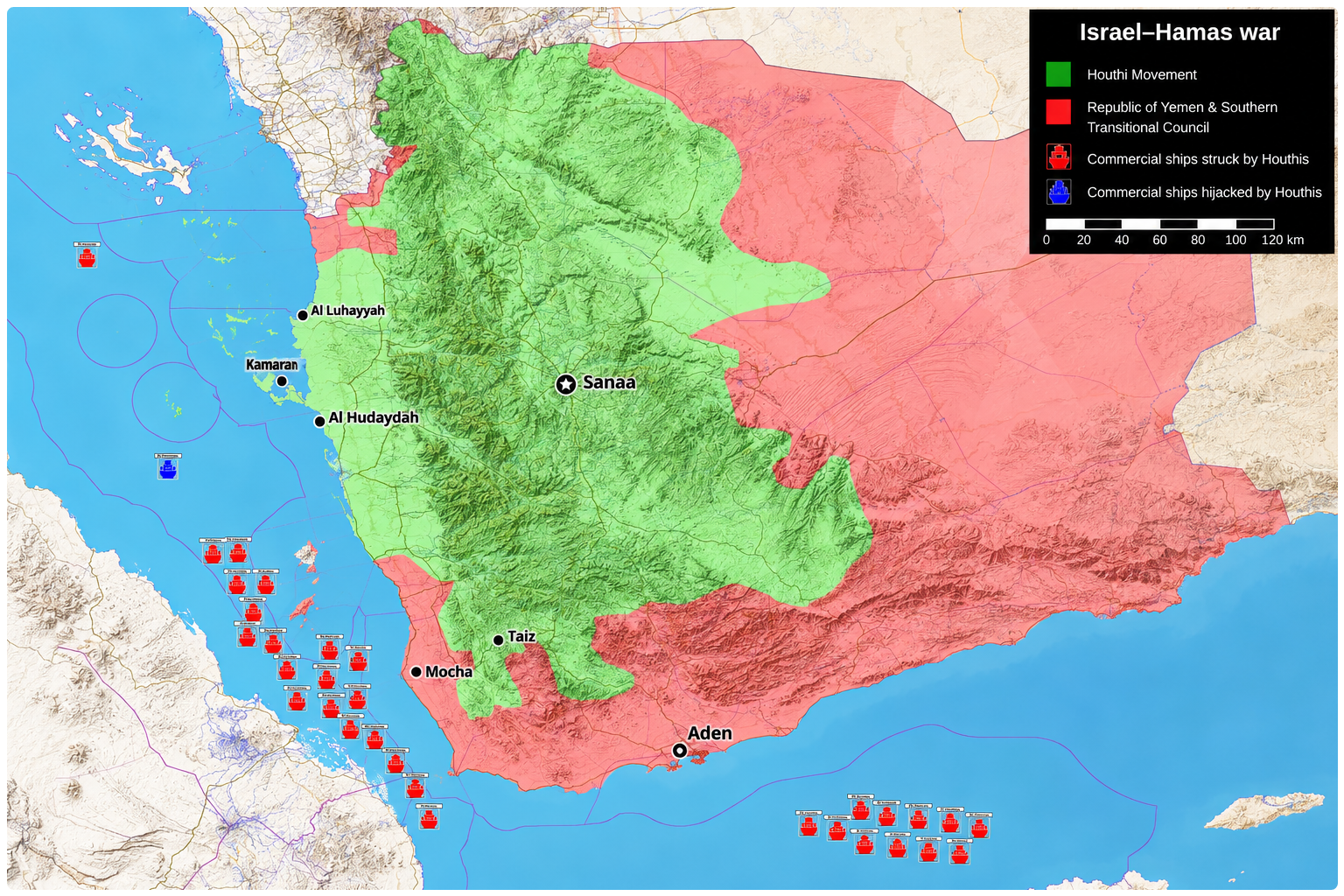
Saudi-backed Yemeni government forces say they have driven the Houthis from large parts of the coast surrounding the Bab el-Mandeb Strait, reversing major territorial gains made by the Iran-aligned movement less than a month ago.
The offensive reportedly recovered the Dhubab district, the port city of Mocha and several positions overlooking the narrow waterway connecting the Red Sea with the Gulf of Aden. Yemen’s Defence Ministry declared Mocha under government control, while military sources said operations were continuing to clear coastal roads and cut Houthi supply lines.
The advances were led by the Homeland Shield Forces and the Giants Brigades, two powerful formations aligned with Yemen’s internationally recognised government. Saudi aircraft provided extensive air support, striking Houthi positions, vehicles and reinforcements along the western coast.
Los mercenarios saudies y el ejercito de yemen estan persiguiendo a los huties por la costa del estrecho mandeb y los pisan con los autos Una bronca tenian https://t.co/aGBigMfh4P
— ElBuni (@therealbuni) October 5, 2026
Saudi-led coalition spokesman Major General Turki al-Maliki said approximately 100 fighter aircraft had been assigned to the operation and claimed that hundreds of Houthi targets had been destroyed. The coalition described its intervention as necessary to protect Bab el-Mandeb and prevent the Houthis from controlling a route central to global trade and energy shipments.
The complete battlefield picture remains difficult to establish. Houthi-aligned outlets have disputed government claims and accused the coalition of exaggerating its gains. Independent access to the front lines is limited, while neither side has released evidence sufficient to confirm the full extent of the territorial changes.
The status of Perim, also known as Mayun, is particularly important. The volcanic island lies inside Bab el-Mandeb and divides the strait into two navigational channels. The Houthis captured Perim Island during their September offensive, giving them a strategically valuable position beside vessels entering and leaving the Red Sea.
Government forces have reported cutting roads leading towards the strait, but they have not conclusively demonstrated that Perim itself has been retaken. Until the island’s status is established, claims that the Houthis have been completely removed from Bab el-Mandeb should be treated cautiously.
The counteroffensive nevertheless marks a sharp reversal. In September, Houthi forces moved rapidly down Yemen’s western coast, seizing Mocha before advancing into Dhubab. Their capture of coastal territory and nearby islands placed the movement in a stronger position to threaten commercial vessels passing between the Indian Ocean and the Suez Canal.
Bab el-Mandeb, whose name translates as the “Gate of Tears”, is only about 29 kilometres wide at its narrowest point. Ships travelling between Asia and Europe through the Suez Canal must cross the strait or take the much longer route around Africa’s Cape of Good Hope.
The US Energy Information Administration has previously documented how insecurity around Bab el-Mandeb forced changes in oil movements through the region. Any sustained disruption can increase voyage times, fuel expenditure, freight rates and war-risk insurance costs.
The waterway has assumed still greater importance because of disruption around the Strait of Hormuz. Saudi Arabia can move oil from its eastern fields through the East-West Pipeline to Yanbu on the Red Sea, bypassing Hormuz. Tankers carrying that crude towards Asian markets, however, must then sail south through Bab el-Mandeb.
The Houthi advance therefore threatened both Yemen’s internationally recognised government and Saudi Arabia’s alternative oil-export route. Riyadh subsequently began preparing a larger campaign, and reports that more than 100,000 Yemeni troops were being assembled indicated that the response could extend beyond a limited coastal operation.
The current campaign follows weeks of escalating missile and drone attacks. The Houthis have claimed strikes against Saudi airports, military facilities and oil infrastructure, while the Saudi-led coalition has intensified air operations across Sanaa, Saada, Taiz and the western coastline. Several of the competing claims remain unverified.
Yemen’s present conflict began after the Houthis seized Sanaa in 2014 and forced the internationally recognised government from the capital. Saudi Arabia led a military intervention the following year, but years of bombing and ground combat failed to dislodge the movement from northern Yemen.
A United Nations-mediated truce in 2022 substantially reduced cross-border attacks and froze many front lines, even after the agreement formally expired. That period of relative restraint has now collapsed, displacing more than 170,000 people during the renewed fighting and placing additional pressure on communities already facing hunger and damaged public services.
Retaking Dhubab and Mocha would deprive the Houthis of much of the coastal territory gained during their September offensive. It would also reduce their ability to position shorter-range weapons immediately beside one of the world’s most sensitive maritime passages.
The outcome, however, remains unsettled. Government forces must hold the recovered territory, establish the status of Perim and prevent the Houthis from returning through the surrounding mountains and coastal roads. The battle for Bab el-Mandeb has shifted in their favour, but control of the strait will depend on whether the counteroffensive can survive the next Houthi response.