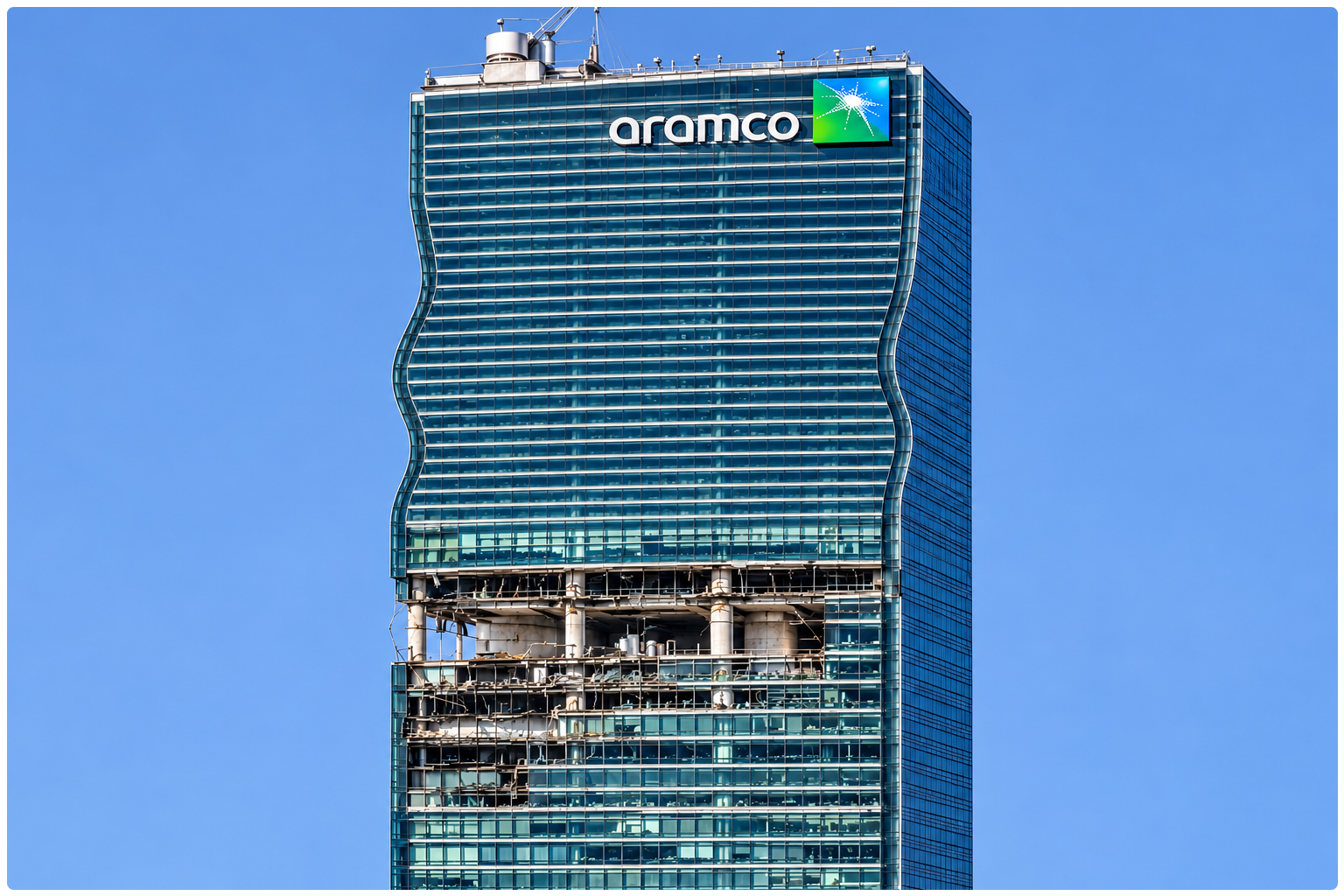
Shattered windows across several floors of Saudi Aramco's office tower in Riyadh's King Abdullah Financial District marked the latest Houthi assault on the kingdom on Sunday, November 8. Saudi authorities attributed the damage to falling missile fragments following air defence interceptions and reported no deaths or injuries.
The attack reached one of Riyadh's most prominent business districts, home to financial institutions, corporate offices, residential buildings and a metro station. Aramco Tower, a distinctive skyscraper within the development, sustained damage to its glass exterior as explosions were heard across the capital.
An official statement from Saudi Arabia's Ministry of Energy, carried by the Saudi Press Agency, described the incident as an attempted attack against an administrative building belonging to Aramco. The ministry said fragments caused limited damage and that emergency authorities had responded.
The Saudi-led coalition separately announced that air defences had intercepted two ballistic missiles directed towards Riyadh. Additional missiles were reportedly destroyed over the Eastern Province and southern Saudi Arabia, while civil defence authorities issued warnings to residents before declaring the danger over.
Saudi Arabia: One of the missiles launched by the Yemeni Houthis struck a Saudi Aramco tower located within the King Abdullah Financial District (KAFD) in the Saudi Arabian capital, Riyadh...08-11-2026 https://t.co/Aq0nzMPMow
— Rowan Van Dijk (@Lastkombo) November 8, 2026
The Houthis claimed responsibility for a wider series of operations involving ballistic missiles, cruise missiles and drones. Military spokesman Yahya Saree said the group's targets included Riyadh's financial district, King Khalid International Airport and Aramco-linked energy installations.
His statement also identified facilities at Khurais and an oil pumping station in Dawadmi, alongside Saudi military positions. The Houthis claimed successful strikes, but Saudi authorities have not confirmed damage at all the locations named.
The differing accounts leave the precise circumstances of the damage to Aramco Tower unresolved. Saudi officials maintain that intercepted missile fragments struck the building, while the Houthis have portrayed their operation as a successful attack against strategic targets.
The physical damage is evident in images of broken windows and affected sections of the tower. It has not been independently established whether an intact projectile struck the building or whether the destruction resulted entirely from interception debris.
Aramco has not announced any interruption to crude production, refining or exports resulting from the Riyadh incident. The damaged property is an administrative building, not an oil-processing or production installation.
The company has faced attacks on several parts of its infrastructure during the renewed conflict. In October, an administrative building at Aramco's headquarters in Dhahran was damaged, while the Houthis subsequently claimed missile operations against Ras Tanura, Abqaiq and Rabigh.
The latest attacks followed another escalation inside Yemen. On November 7, Houthi-controlled health authorities said Saudi-led airstrikes had killed at least 33 people near Sanaa, including women and children. The Saudi-led coalition said it was investigating the reported strikes, while the casualty figures remained independently unverified.
The renewed confrontation has placed Saudi civilian and commercial infrastructure under repeated threat, even as Riyadh has sought diplomatic support and stronger regional security arrangements.
Sunday's incident caused no reported casualties at the Aramco building, but it brought the effects of Yemen's war into Riyadh's financial centre. Saudi authorities have yet to release a detailed assessment explaining how the fragments reached the tower or whether further repairs and security restrictions will be required.