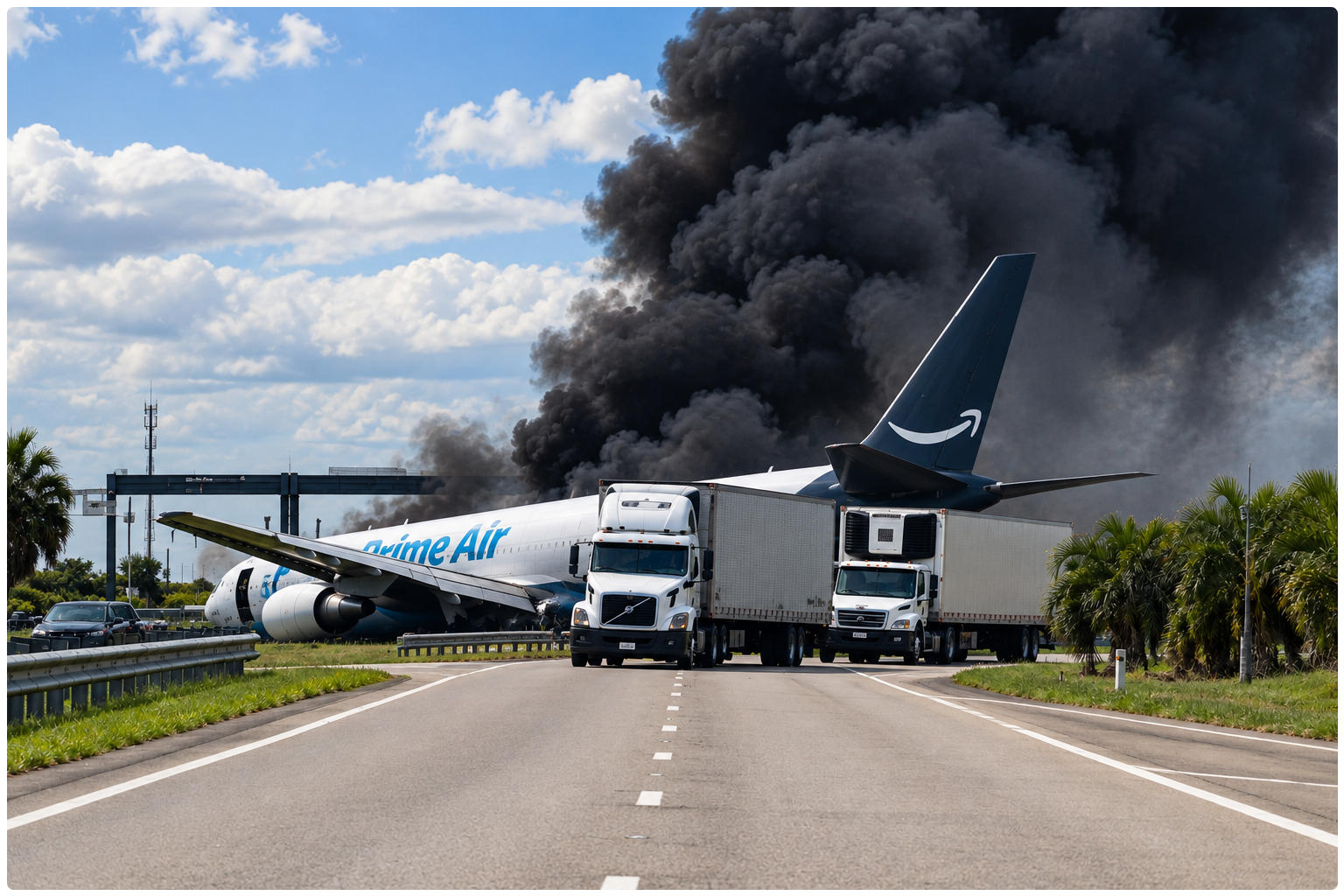
At least five people were killed and five others injured after an Amazon Prime Air cargo aircraft overran a runway while landing at Miami International Airport, crossed a road and struck several vehicles before catching fire.
The accident occurred shortly before 2 p.m. local time on Sunday when Prime Air Flight 7598, a Boeing 767-300 freighter, was arriving in Miami from San Juan, Puerto Rico.
The aircraft was operated by North Carolina-based cargo carrier 21 Air on behalf of Amazon.
According to authorities, the plane failed to stop after landing on Runway 30 and continued beyond the airport boundary. It crossed Northwest 67th Avenue before striking vehicles and eventually coming to rest outside the runway area.
The crash triggered a major emergency response as flames and thick black smoke rose from the aircraft.
Miami-Dade Fire Rescue Chief Ray Jadallah described the scene as a “very complex situation.” More than 60 fire rescue units were deployed, with firefighters using foam and specialised airport firefighting equipment to extinguish the blaze.
Five people were taken to hospital. Three were in critical condition, while two suffered less severe injuries.
The pilot and co-pilot were initially trapped inside the aircraft's cockpit following the crash. Several people were also trapped inside vehicles struck by the plane, while another person had to be rescued after becoming pinned beneath a vehicle.
Authorities have not yet publicly identified those killed and have not confirmed whether all of the fatalities were people on the ground or whether some were aboard the aircraft.
The National Transportation Safety Board has launched an investigation and dispatched a team to Miami to determine why the aircraft overran the runway.
Investigators are expected to examine the aircraft's braking and other systems, the crew's approach and landing, runway conditions and weather at the time of the accident.
One question will be whether the Boeing touched down too far along the runway, reducing the distance available for it to stop.
Weather could also form part of the investigation. Thunderstorms were reported around Miami on Sunday, while winds gusting to around 30 mph were recorded in the area. Investigators have not determined whether those conditions contributed to the crash.
The aircraft involved was a 32-year-old Boeing 767-300. It was originally built as a passenger aircraft and operated for several airlines before being converted into a freighter in 2015.
Attention is also likely to focus on safety infrastructure surrounding the runway. The Associated Press reported that Miami International does not have the Federal Aviation Administration-recommended arresting system at the end of the runway involved in Sunday's crash. Such systems are designed with crushable material that can help slow an aircraft that overruns a runway.
The accident caused major disruption at one of the United States' busiest international airports. Airport operations were temporarily halted, and more than 160 flights were cancelled while hundreds of others were delayed. Two of the airport's four runways were later reopened.
Amazon said it was “heartbroken” by the deaths and expressed sympathy to the victims' families and others affected by the crash.
The company said it was working with local authorities and would cooperate fully with the investigation.
The Federal Aviation Administration is also investigating alongside the NTSB. With the wreckage, flight data and cockpit information now central to the inquiry, investigators will seek to reconstruct the aircraft's final approach and determine why a routine cargo flight ended in one of the deadliest accidents at Miami International Airport in recent years.