India and Switzerland have signed five agreements covering migration, young professionals, transport technology, scientific research and start-up development as the two countries move to broaden a relationship traditionally dominated by trade and investment.
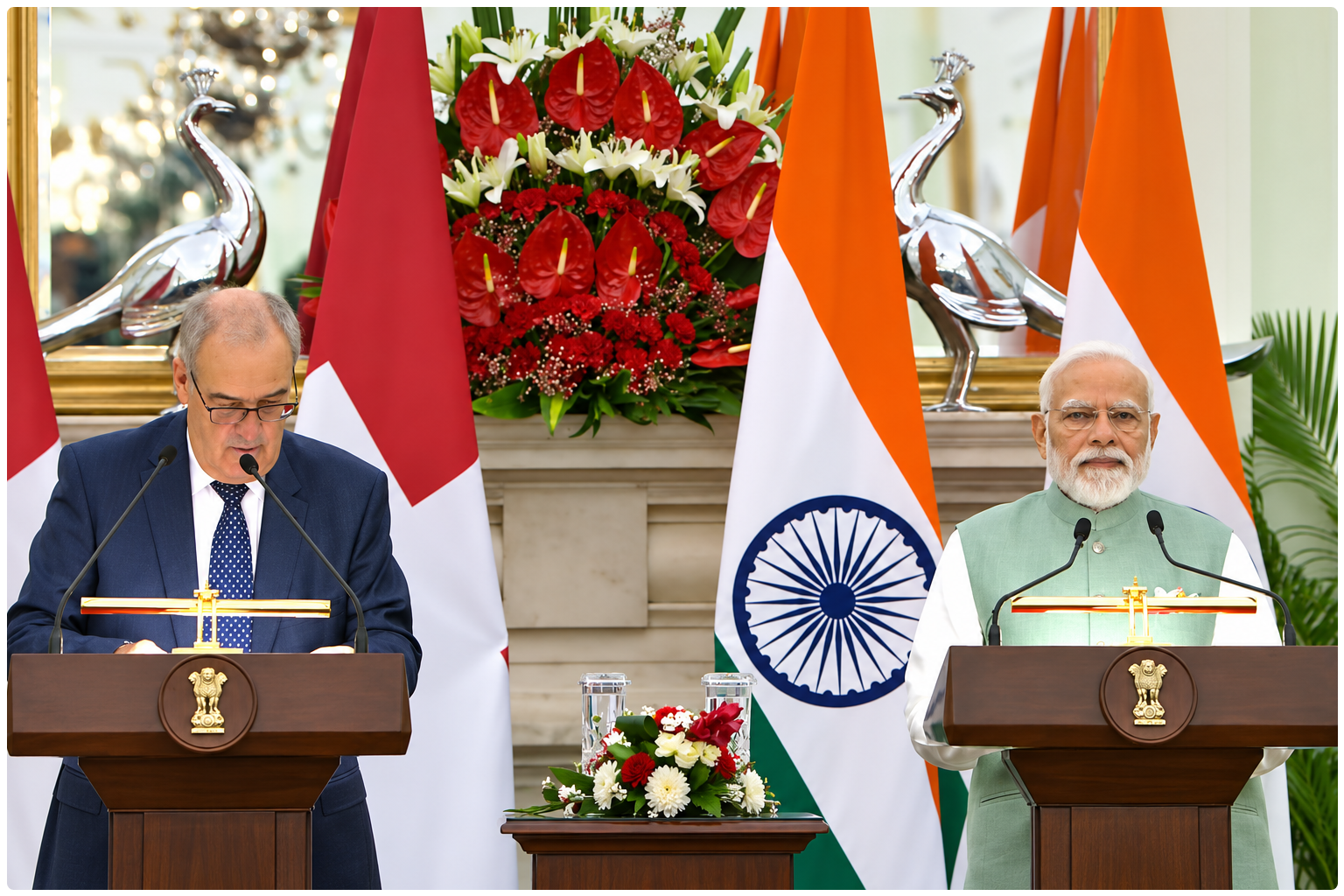
The agreements were announced following talks in New Delhi between Prime Minister Narendra Modi and Swiss Confederation President Guy Parmelin, who travelled to India with a business delegation. President Droupadi Murmu also received Parmelin at Rashtrapati Bhavan and hosted a banquet in his honour.
The most detailed agreement establishes a Migration and Mobility Partnership intended to create clearer legal routes for students, professionals and other eligible travellers while strengthening cooperation against irregular migration, human trafficking and exploitation. The framework provides for multiple-entry visas valid for up to five years, although individual stays would generally be limited to six months at a time. It also includes renewable one-year residence permits for qualifying students.
A separate Young Professionals Scheme will allow recently qualified Indians and Swiss citizens to obtain temporary employment in the other country to develop professional and language skills. Up to 300 participants from each country will initially be admitted every year, with the limit potentially rising to 500.
The two governments also signed an agreement on transport technologies, mobility systems and infrastructure. Cooperation is expected to cover electric vehicles, ropeways, tunnels, waste reduction and the use of circular-economy principles in transport projects. Swiss engineering experience is already visible in major Indian infrastructure programmes, including the Varanasi ropeway, Noida International Airport and railway and tunnelling projects.
Scientific cooperation forms another important part of the package. India’s Department of Science and Technology and the Swiss National Science Foundation signed a letter of intent supporting long-term research partnerships and joint projects in mutually selected fields.
A fifth arrangement links the Department of Science and Technology with the Zurich University of Applied Sciences. It will support the Indo-Swiss Academia-Industry Training programme, bringing together early-stage start-ups, researchers and industry specialists through exchanges, workshops, mentoring and business networks. Health, clean energy and space are among the fields identified for expanded research.
Defence production and nuclear energy were discussed during the summit but were not covered by the five signed agreements. Modi said the two countries had identified possibilities for military exchanges and defence manufacturing, suggesting that future cooperation could include contacts between their armed forces and partnerships involving Indian and Swiss companies. No procurement programme, manufacturing contract or specific military platform was announced.
The leaders similarly agreed to deepen civil nuclear-energy cooperation, although the two governments did not announce a reactor project, fuel agreement or technology-transfer arrangement. The discussion nevertheless signals that energy security and advanced technology are becoming more prominent in the bilateral relationship.
The visit came one year after the India-European Free Trade Association Trade and Economic Partnership Agreement entered into force. EFTA comprises Switzerland, Norway, Iceland and Liechtenstein. Under the agreement, the four countries have committed to promoting $100 billion in investment and one million direct jobs in India over 15 years.
Those figures represent collective EFTA objectives rather than guaranteed Swiss investment. However, Switzerland is the bloc’s largest economy and is expected to account for a significant portion of the commercial activity generated by the agreement. India is seeking greater exports of pharmaceuticals, engineering goods, textiles and agricultural products, while Swiss companies are exploring opportunities in biotechnology, financial services, food processing, advanced manufacturing and clean technology.
The Swiss side is also seeking greater certainty for investors and progress on intellectual-property protection. These questions will influence whether the ambitious investment and employment targets translate into factories, research centres and long-term business projects.
The Swiss visit forms part of India’s wider effort to strengthen its economic and strategic relationships across Europe. New Delhi has recently pursued expanded defence-industrial cooperation with Belgium while securing greater access to Europe’s protected steel market. India’s strong economic performance has also increased its attraction as an investment destination, with global financial leaders highlighting the country’s growth and expanding domestic market.
The five agreements create practical mechanisms for movement, research and infrastructure cooperation. The next test will be whether the broader understandings on defence production, military exchanges and nuclear energy develop into formal projects.