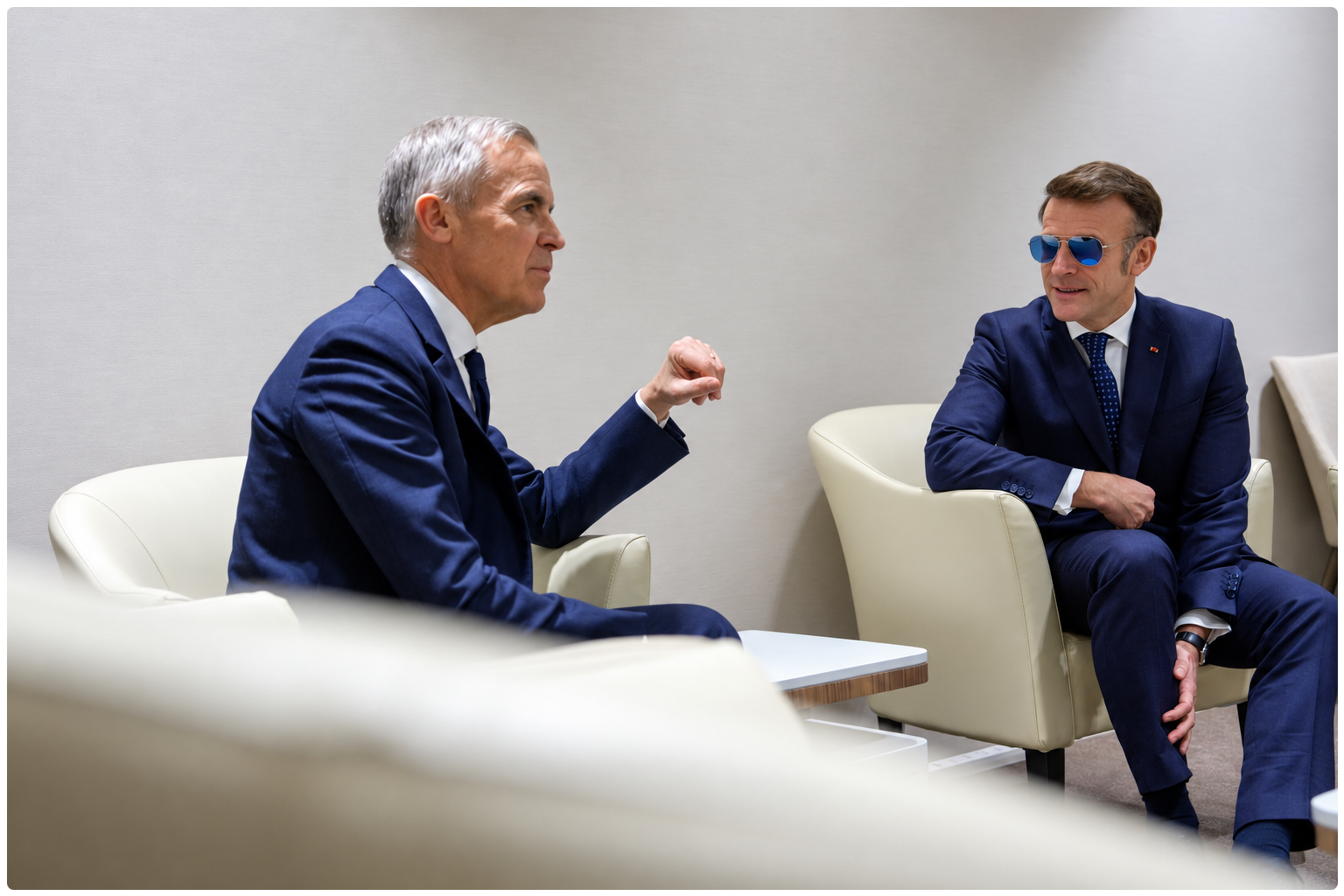
French President Emmanuel Macron and Canadian Prime Minister Mark Carney are meeting in Saint Pierre and Miquelon, a small French archipelago just off Canada’s Atlantic coast, in a visit carrying an unusually large geopolitical message for such a remote territory.
Carney is due to arrive on September 20 for a working lunch with Macron, followed by a wreath-laying ceremony and joint statement. The Canadian government says the two leaders will discuss deeper cooperation in aerospace, energy, critical minerals, quantum technology, satellites and supercomputing, as Ottawa continues building closer economic and security ties with Europe.
But the location is what gives the meeting much of its symbolism.
Saint Pierre and Miquelon is a French overseas territory lying just south of Newfoundland. Macron’s visit places the leaders of France and Canada together on French soil only a short distance from the Canadian mainland, at a time when both governments are navigating a more difficult relationship with Washington.
The meeting comes weeks after US President Donald Trump circulated an image depicting American flags across several North American territories, including Saint Pierre and Miquelon. That followed months of increasingly confrontational rhetoric from Washington towards neighbouring and allied countries, including Trump’s repeated push for greater US control over Greenland and threats of tariffs linked to Canadian and European policy decisions.
Neither Macron nor Carney has formally presented the meeting as an anti-American summit. Canada says France is one of its oldest and closest partners and describes the relationship as part of a wider effort to build stronger international economic and security connections.
Still, the broader political context is difficult to separate from the choice of venue.
Carney has spent much of his premiership trying to reduce Canada’s dependence on the United States, particularly as trade disputes and tariff threats have made Washington a less predictable economic partner. He has pushed for closer ties with Europe in defence, energy, critical minerals, artificial intelligence and digital trade.
France has been moving in a similar direction. Macron has repeatedly called for greater European “strategic autonomy”, arguing that Europe should have the ability to protect its economic and security interests without being excessively dependent on Washington.
That makes Saint Pierre and Miquelon an unusually fitting setting.
The archipelago is geographically surrounded by North America but politically part of France. For Paris, it is a reminder that France itself is an Atlantic and Arctic power with territory and maritime interests close to Canada. For Ottawa, the meeting provides another opportunity to demonstrate that Canada has strategic partners beyond the United States.
The talks are expected to have substantial economic content. Canada is seeking greater cooperation with Europe on defence manufacturing, aerospace and technology, while France has an interest in Canadian energy and critical minerals. Both countries are also increasingly focused on Arctic security as competition involving the United States, Russia and China intensifies across the region.
But the political imagery may attract as much attention as any agreements announced.
A French president and a Canadian prime minister meeting on a tiny piece of French territory just off Canada's coastline sends a visible reminder that North America is not exclusively an American strategic space. It also comes as traditional US allies are increasingly discussing how to protect their own interests when Washington itself applies economic or political pressure against them.
The meeting is therefore unlikely to be remembered simply for what Macron and Carney discuss over lunch. Saint Pierre and Miquelon has become the backdrop for a much larger shift: Canada and European powers are exploring how much more independently they can operate as the assumptions that once underpinned their relationship with the United States become less certain.