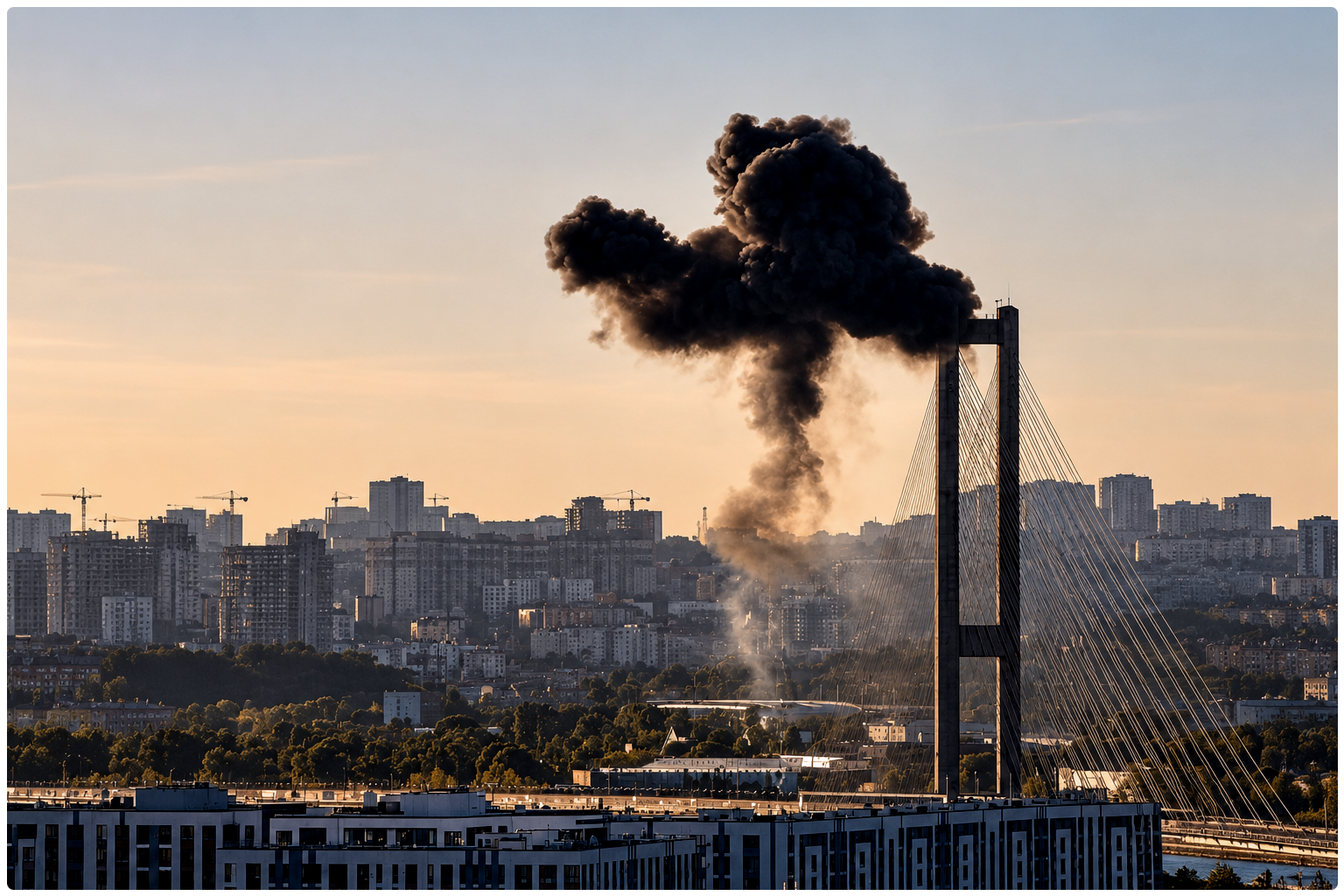
Repeated Russian drone strikes have damaged Kyiv’s Southern Bridge and forced restrictions across two other critical crossings over the Dnipro River, bringing traffic close to collapse and exposing a dangerous weakness in the Ukrainian capital’s transport network.
The Southern Bridge, also known as the Pivdennyi Bridge, was struck several times between October 1 and 2. Kyiv city authorities said the attacks damaged a bridge support, sections of the road surface, a safety barrier and protective concrete structures surrounding the metro line.
The crossing was completely closed to road traffic while engineers examined its structural condition. Metro services using the bridge were also suspended pending assessments by specialist institutions.
⚡️ Russia hits Kyiv’s Pivdennyi (Southern) Bridge. Cutting this vital Dnipro crossing paralyzes a major metro line and splits the capital's supply lines in two. pic.twitter.com/WRlFAQ9Qby
— Jason Jay Smart (@officejjsmart) October 1, 2026
The attacks created disruption across three major crossings. The Paton Bridge was closed or restricted at different stages, while traffic on the Metro Bridge was limited towards Kyiv’s western bank. There was no confirmation that these two bridges had been directly struck, but security measures and the closure of the Southern Bridge placed enormous pressure on the remaining routes.
Municipal transport services diverted buses through the Darnytskyi Bridge as queues of cars and public transport vehicles spread across the city. Some commuters abandoned their vehicles and continued their journeys on foot.
The Dnipro divides Kyiv geographically and economically. More than a third of the capital’s estimated three million residents live on the eastern bank, while much of its government, employment and commercial activity is concentrated on the western side. Any prolonged reduction in bridge capacity could delay ambulances, restrict emergency services, interrupt deliveries and complicate evacuations.
The disruption comes as Russia intensifies its aerial campaign using faster jet-powered drones that are more difficult to intercept and provide Ukrainian air defences with less time to respond.
Russia maintains that its military targets infrastructure connected to Ukrainian combat and logistical operations. Bridges carry personnel, equipment and supplies across the Dnipro, giving them considerable importance in a war in which both countries are increasingly attacking transport, industrial and energy infrastructure.
Ukraine has simultaneously expanded its own long-range campaign against Russian oil refineries and defence facilities. Kyiv has also placed its domestically developed FP-7 ballistic missile into combat, marking a significant expansion of its strike capabilities. The Global Voice previously examined the FP-7 deployment and the widening exchange of deep strikes between the two countries.
The economic consequences are becoming increasingly visible. ArcelorMittal recently said it could not safely restart its Kryvyi Rih steelworks after four missile strikes in five weeks killed five people, injured 17 and extensively damaged the plant’s energy and blast-furnace infrastructure. The company expects to record a non-cash impairment of approximately $1 billion.
ArcelorMittal’s official statement said the facility could no longer be operated safely or sustainably. The Global Voice reported separately on the steelworks shutdown, which removed one of Ukraine’s largest industrial facilities from production.
Kyiv has not been divided completely, as several crossings remain available. The alarm lies in what repeated strikes could do over time. Progressive damage to bridges, metro lines, power facilities and industrial plants could steadily reduce Ukraine’s ability to move people, maintain production and keep its cities functioning as winter approaches.