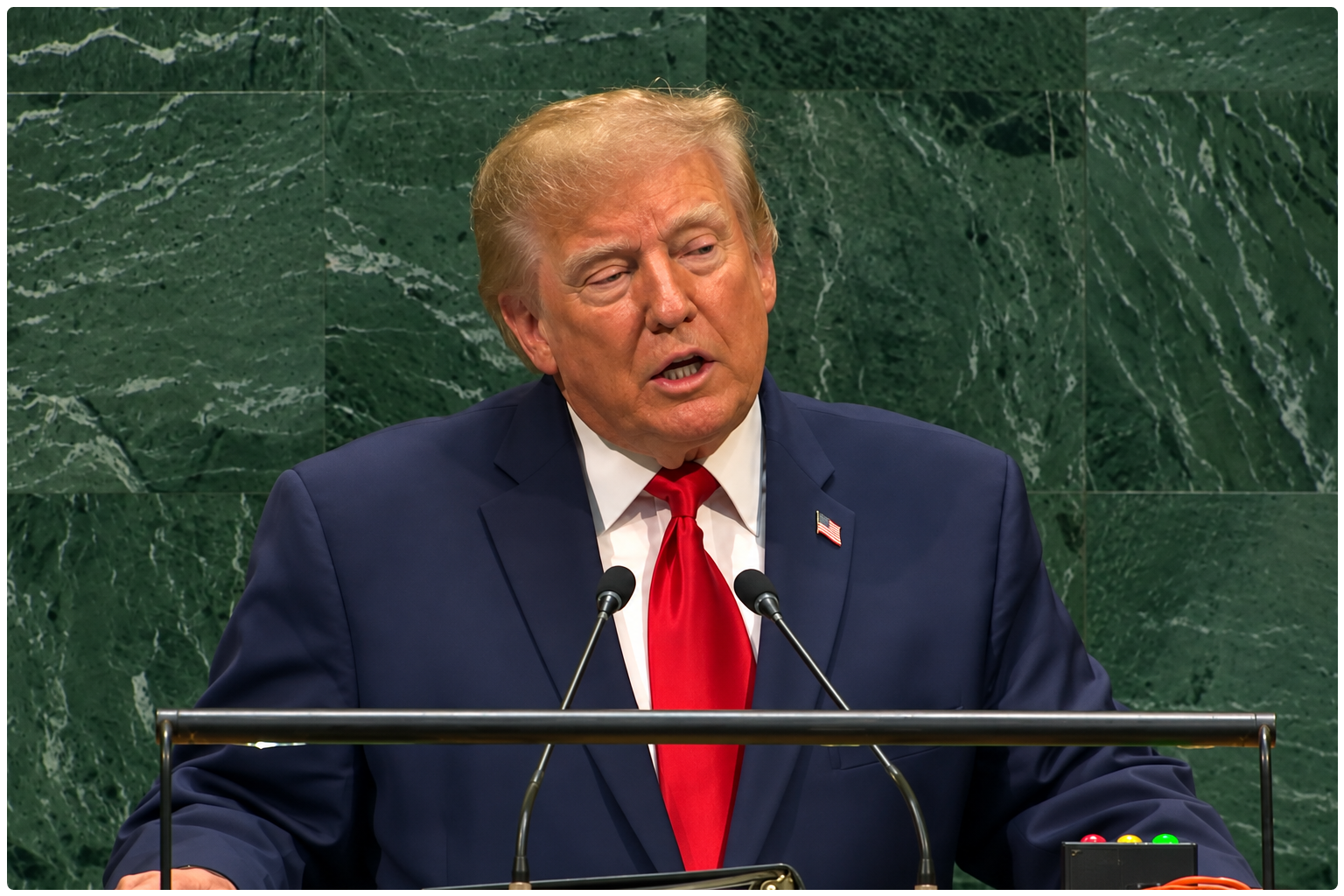
US President Donald Trump has threatened to “annihilate” the Islamic Republic if Iran fails to reach an agreement ending the nearly seven-month war, sharply escalating his rhetoric even as indirect diplomatic contacts continue.
Addressing the United Nations General Assembly in New York, Trump presented Tehran with a choice between accepting a deal that would allow Iran to rebuild or facing another destructive American military campaign.
“Or do I annihilate the Islamic Republic and do it quickly?” Trump asked, warning that he would not allow Iran another opportunity to threaten neighbouring countries. He also called on other governments to intensify Iran’s economic isolation until its leadership returned to negotiations.
The statement was a threat rather than an announcement of an immediate military operation. Trump did not identify specific targets, present a timetable or explain what conditions would trigger a renewed offensive.
President Trump labeled himself a man of peace while threatening to “annihilate” Iran and wield American power against other nations. pic.twitter.com/kHDUrIYwYK
— Seattle Smith🇺🇸 (@smith_seattle1) September 23, 2026
Most members of Iran’s delegation walked out of the General Assembly hall during the speech. Tehran has not accepted Washington’s demand for a settlement on American terms and has maintained that further attacks will produce a wider military response against US forces and interests across the region.
The threat came as the two governments continued communicating through intermediaries. After his speech, Trump initially said American and Iranian officials had held a “very good” three-hour meeting. He later clarified that his envoys, Steve Witkoff and Jared Kushner, had met mediators representing Iran rather than Iranian officials directly.
Iran recently conveyed its conditions for ending the conflict through Qatar. These reportedly include an end to military operations on all fronts, the release of frozen Iranian funds and the lifting of the US naval blockade. Iranian officials have said they remain willing to pursue diplomacy but will not negotiate under threats.
Trump predicted that an agreement could emerge after the US midterm elections on November 3. He accused Tehran of delaying negotiations in the hope that an unfavourable election result would weaken his position, but insisted that domestic politics would not affect his handling of the war.
The conflict began in late February when the United States and Israel launched strikes against Iran. The attacks killed senior Iranian political and military leaders, including Supreme Leader Ayatollah Ali Khamenei, and severely damaged the country’s conventional military capabilities.
Iran responded with missile and drone attacks on American forces and regional targets. Fighting has since expanded into maritime routes, energy infrastructure and conflicts involving Iran-aligned groups. Exchanges of fire resumed in recent weeks after a period of reduced military activity.
The Strait of Hormuz remains central to negotiations because restrictions and attacks in the surrounding waters have disrupted energy markets and contributed to higher oil prices. Trump demanded that Iran fully reopen the passage, while Tehran has linked maritime normalisation to an end to the blockade and American attacks.
Trump has previously used threats of overwhelming destruction to pressure Iran. In April, he warned that American forces could destroy bridges, power stations and other infrastructure if Tehran failed to meet his deadline language that raised questions about the protection of civilian facilities during wartime.
His latest statement therefore combines coercion with an apparent diplomatic opening. The administration is signalling that negotiations remain possible, but it is also warning that failure could bring a major escalation.
Whether this pressure produces an agreement will depend on whether the two governments can bridge their differences over Iran’s nuclear programme, sanctions, maritime access and regional military activity. For now, the negotiations remain indirect, and the threat of renewed large-scale fighting has not receded.