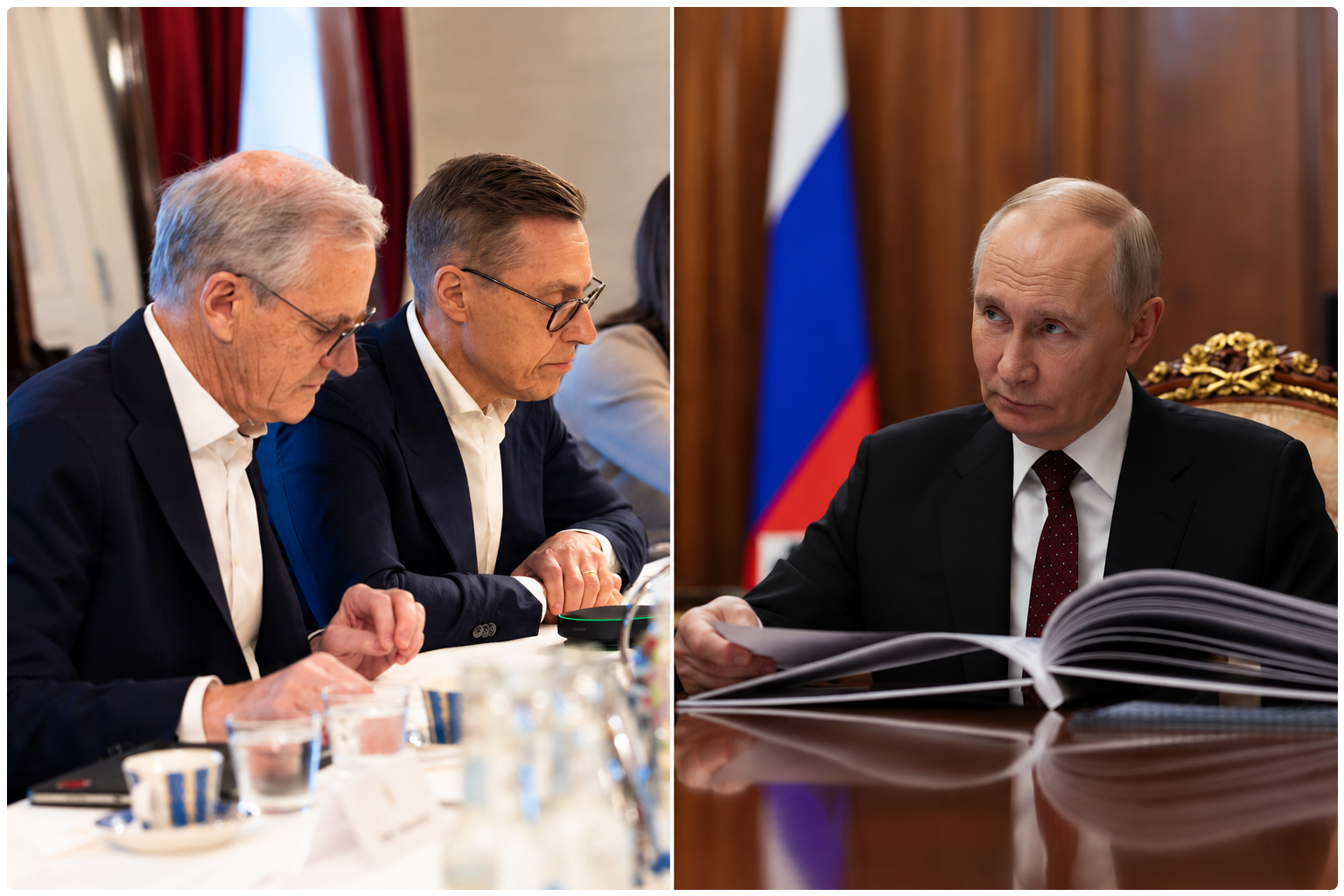
The leaders of Finland and Norway have spoken directly with Vladimir Putin for the first time in more than four years, reopening a diplomatic channel with Moscow as preparations intensify for another attempt to negotiate an end to the Ukraine war.
Finnish President Alexander Stubb and Norwegian Prime Minister Jonas Gahr Støre held the joint telephone call from Helsinki on October 27. They initiated the conversation to convey messages concerning planned negotiations involving Russia, Ukraine and the United States.
The contact was connected to prospective meetings in Abu Dhabi, where American mediators are seeking to revive three-way talks. The precise date and participant list have not been announced.
In a joint account of the conversation, Finland and Norway described the discussion as frank and substantive. Stubb said the consequences of the war directly affect both countries and wider European security, while Støre emphasised the enormous human and material costs of the conflict.
Both leaders urged de-escalation and reaffirmed their continuing support for Ukraine. They subsequently spoke with Ukrainian President Volodymyr Zelenskyy to brief him on the conversation, reducing the risk that the initiative would be interpreted as negotiations conducted without Kyiv.
The call followed Zelenskyy’s recent visit to Oslo, where he met Stubb, Støre and representatives involved in the American peace effort. The discussions covered possible security guarantees, military support, reconstruction and the conditions required for a settlement.
US envoy Steve Witkoff subsequently travelled to Russia carrying proposals developed after the Oslo talks. Moscow later accepted in principle the resumption of technical discussions with Ukraine and the United States, although no agreement was reached on territory, a ceasefire or postwar security arrangements.
For Norway, Tuesday’s conversation was Støre’s first direct exchange with Putin since March 31, 2022. During that earlier call, held weeks after Russia’s full-scale invasion, the Norwegian prime minister demanded an end to the war and raised concerns about civilian suffering.
Finland’s last presidential contact came in May 2022, when former president Sauli Niinistö informed Putin that the country intended to apply for NATO membership. Finland subsequently joined the alliance in April 2023, ending decades of military non-alignment and turning its 1,340-kilometre border with Russia into NATO’s longest direct frontier with the country.
The renewed contact does not indicate that either Nordic government is weakening its support for Ukraine. Norway remains one of Kyiv’s most substantial financial and energy supporters, while Finland has supplied military equipment and strengthened its defences along the Russian border.
It does, however, represent a change in diplomatic method. Most Western European leaders have sharply limited direct communication with Putin since 2022, arguing that repeated conversations produced little movement while allowing Moscow to claim international legitimacy.
That approach has increasingly left European governments dependent on Washington for information about negotiations with Russia. The concern has grown as President Donald Trump has eased economic pressure on Moscow and developed a more difficult relationship with Zelenskyy.
Denmark’s Prime Minister Mette Frederiksen criticised the Finnish-Norwegian initiative, arguing that European countries should remain united rather than pursue separate contacts. Stubb and Støre stressed that they spoke only for their own governments, not for Europe or NATO.
The Kremlin’s account gave no indication that Putin had softened his position. Moscow said a lasting settlement would require Russia’s interests to be fully considered and accused NATO and the European Union of prolonging the fighting.
Russia continues to demand control over territory it claims to have annexed, including parts of the Donbas that its forces do not fully occupy. Ukraine rejects any settlement requiring it to surrender additional land and wants enforceable guarantees against another invasion.
The call therefore reopened communication without resolving the central disputes. Its immediate value lies in giving two European governments bordering Russia a direct channel into negotiations increasingly shaped by Washington.
Whether that channel becomes useful will depend on what follows in Abu Dhabi. If Moscow enters substantive negotiations, Finland and Norway may have created a limited European route into the process. If Putin repeats existing demands without compromise, the call will demonstrate the limits of renewed contact rather than the beginning of a diplomatic breakthrough.