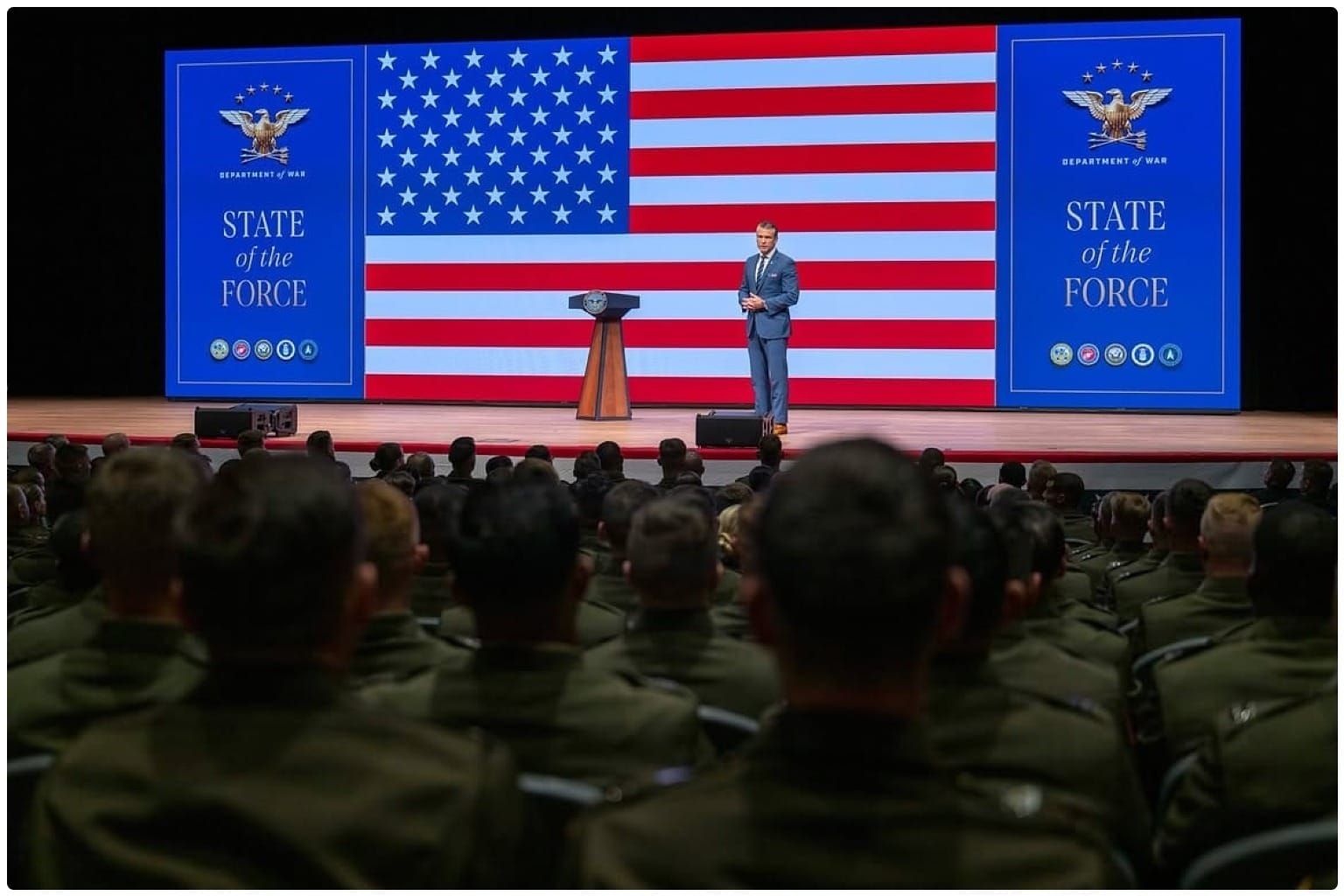
The Pentagon has announced the creation of the Autonomous Warfare Command, known as AutoWarCom, a new four-star military command dedicated to expanding the United States’ use of drones, robotics and artificial intelligence across the armed forces.
Defence Secretary Pete Hegseth unveiled the command during a “State of the Force” address at Marine Corps Base Quantico in Virginia. He described it as a combatant command with service-like powers to develop, purchase and deploy autonomous systems at greater speed and scale.
“The pace of war is changing faster than the process to support it,” Hegseth said, pointing to the proliferation of inexpensive precision weapons, advanced computing and commercially manufactured drones.
.@SECWAR “Today, at my direction—we are announcing the creation of Autonomous Warfare Command, or AutoWarCom:
— DOW Rapid Response (@DOWResponse) September 30, 2026
A new 4-star combatant command—with service-like authorities—built to scale autonomous and robotic capabilities across the Joint Force in the fastest peacetime shift in… pic.twitter.com/kYWBxy6Dij
AutoWarCom is expected to become operational in October 2027 and will be led by a four-star officer. Establishing a command at that level is rare. The last comparable addition was US Space Command in 2019.
The Pentagon has not yet identified the headquarters, named a commander or released a complete organisational structure. The proposal will also require congressional cooperation for funding and implementation.
The new command is intended to bring together programmes that are currently distributed across the Army, Navy, Air Force, Marine Corps and specialist Pentagon offices. These include unmanned aircraft, robotic ground vehicles, autonomous vessels, counter-drone systems and AI software capable of coordinating large numbers of machines.
The move builds on the Pentagon’s Replicator initiative, which was created to field thousands of relatively inexpensive autonomous systems across multiple military domains. That programme was partly designed to counter China’s advantage in ships, missiles and manufacturing capacity by giving US forces large numbers of disposable or easily replaceable systems.
Responsibility for several autonomous programmes later shifted towards the Defense Autonomous Warfare Group, known as DAWG. AutoWarCom is expected to operate at a much higher level, giving autonomous warfare a permanent place within the US military command structure rather than treating it as a collection of experimental projects.
Recent wars have accelerated this transition. In Ukraine, inexpensive aerial and maritime drones have been used for surveillance, artillery targeting and direct attacks against personnel, vehicles, ships and infrastructure. Drones are estimated to account for a large proportion of battlefield casualties, demonstrating how comparatively cheap systems can threaten tanks, artillery and other expensive platforms.
The United States has also deployed low-cost attack drones during operations against Iran, while American forces have faced repeated drone and missile threats against bases and naval assets. These experiences have increased pressure on the Pentagon to field autonomous systems faster and reduce dependence on limited stocks of expensive missiles.
AutoWarCom will not necessarily mean that machines independently decide when to kill. Existing Pentagon policy requires autonomous and semi-autonomous weapons to allow commanders and operators to exercise “appropriate levels of human judgment” over the use of force.
However, the rapid development of AI raises unresolved questions about how much human supervision will remain possible when hundreds of autonomous systems are operating simultaneously in communications-denied environments. Cybersecurity, target-identification errors and responsibility for unintended attacks will also remain central concerns.
The command’s creation reflects a broader change in American military planning. For decades, the United States relied on smaller numbers of highly sophisticated aircraft, ships and precision weapons. The Pentagon now says it requires both quality and quantity, combining advanced conventional platforms with swarms of cheaper autonomous machines.
AutoWarCom marks an attempt to institutionalise that transformation. Rather than remaining a supporting technology, autonomous warfare is being elevated into a central component of how the United States expects to prepare for and fight future conflicts.