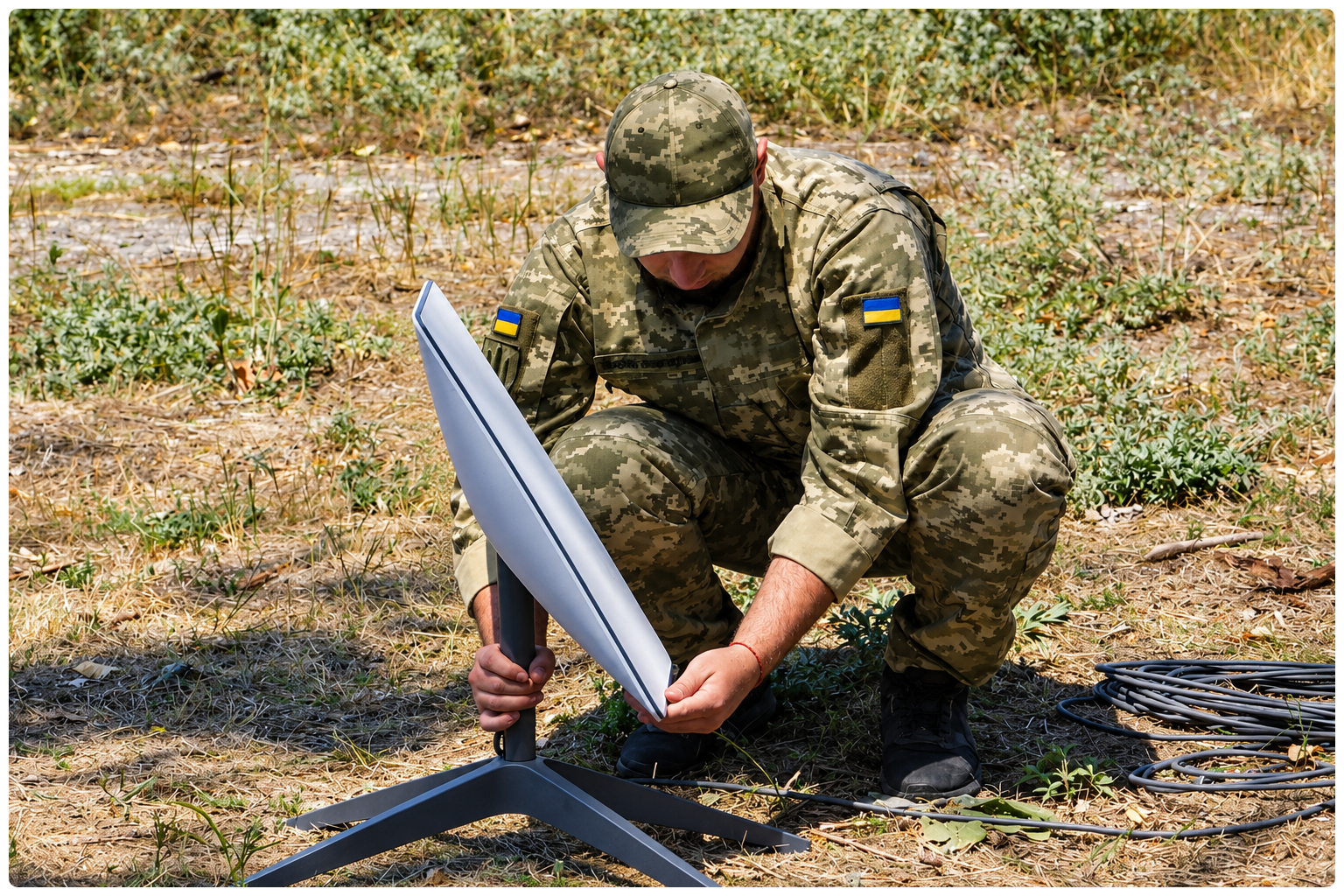
Ukraine says sudden restrictions on the military version of Starlink have disrupted drone operations across the battlefield, forcing some aircraft to fly more slowly and causing several missions to be cancelled.
The restrictions appeared overnight on October 14 and affected Starshield, the military and intelligence service developed by Elon Musk’s SpaceX. Ukrainian forces said terminals mounted on moving platforms began losing connectivity at or below approximately 160 kilometres per hour.
Serhiy Beskrestnov, an adviser to President Volodymyr Zelenskyy on defence technology, said the Ukrainian military received no warning before the change took effect. He confirmed that several missions had been disrupted and said Kyiv was seeking an explanation from SpaceX, the United States and NATO partners.
The effects were not uniform. Units reported losing connections at speeds ranging from about 72 to 161 kilometres per hour, suggesting that the threshold may depend on the terminal, equipment configuration or location.
Thread | THE STARSHIELD FILES 1/7 The night the network slowed Above the Huliaipole front in southeastern Ukraine, drones were already in the air when their satellite links began to fail. The aircraft kept flying. Their operators were losing the ability to steer them. Ukraine's 7th Air Assault Corps reported dropouts of 10 to 20 seconds, in some cases at speeds of only 110 to 120 km/h. Other units described the same problem. Missions were disrupted, and some were cancelled. The limits appeared overnight on October 13 and 14, with no warning to Ukrainian forces. What looked like a battlefield communications failure quickly became a diplomatic dispute involving SpaceX, the Pentagon and the White House. To judge who is responsible, it helps to see first what actually broke, and how a network spread across orbit can put a speed limit on a drone. 2/7 ⬇️
— The Tectonic (@thetect0nic) October 15, 2026
Ukraine’s 7th Rapid Response Corps said drones operating around the Huliaipole front suffered connection losses lasting between 10 and 20 seconds while travelling at 110 to 120 kilometres per hour. The aircraft continued flying, but operators temporarily lost the reliable control required for combat missions.
Slowing the drones creates another problem. A slower aircraft is easier for Russian forces to detect and shoot down, while some medium-range strike drones must accelerate rapidly during launch. Unstable connectivity at those speeds can prevent them from being deployed at all.
The restrictions affect both attack and defensive operations. Ukraine uses satellite-connected drones to strike Russian command posts, supply routes and other targets in occupied territory. Starshield connections are also used by interceptor drones attempting to destroy Russian unmanned aircraft before they reach cities or energy facilities.
Zelenskyy said Russia was already trying to exploit the disruption because Ukrainian interceptor drones depend partly on Starlink. His comments came as Russia launched 39 ballistic missiles and more than 100 attack drones against Ukraine, placing additional pressure on air-defence units.
The timing has raised suspicion in Kyiv, but the reason for the restriction remains unconfirmed. Beskrestnov suggested that it was connected to the political situation between Ukraine and the United States, while Musk said decisions concerning military speeds and usage were controlled by the US government. Washington has not publicly explained whether it requested or approved the change.
Starlink has been crucial to Ukraine since the early months of Russia’s full-scale invasion, providing communications when mobile networks were destroyed or jammed. Its role has since expanded into reconnaissance, frontline logistics, artillery coordination and drone guidance, creating a battlefield dependency that is difficult to replace quickly.
Ukraine’s Defence Ministry is collecting information from affected units and examining backup communication channels. The episode follows earlier cooperation between Kyiv and SpaceX to prevent Russian drones from exploiting Starlink, illustrating the difficulty of restricting enemy access without damaging Ukrainian operations.
The disruption also comes as Washington pressures Kyiv to reduce attacks on Russian oil infrastructure. Ukraine has offered a reciprocal halt to energy strikes, but only if Moscow stops attacking Ukrainian power facilities. Its long-range campaign has already sent hundreds of drones against Russian energy and defence sites and reached Russia’s Arctic gas heartland.
Their immediate military effect, is clear. Some missions have been cancelled, drones are being forced to fly more slowly, and Ukrainian forces are once again confronting the risk of depending on battlefield infrastructure controlled outside the country.