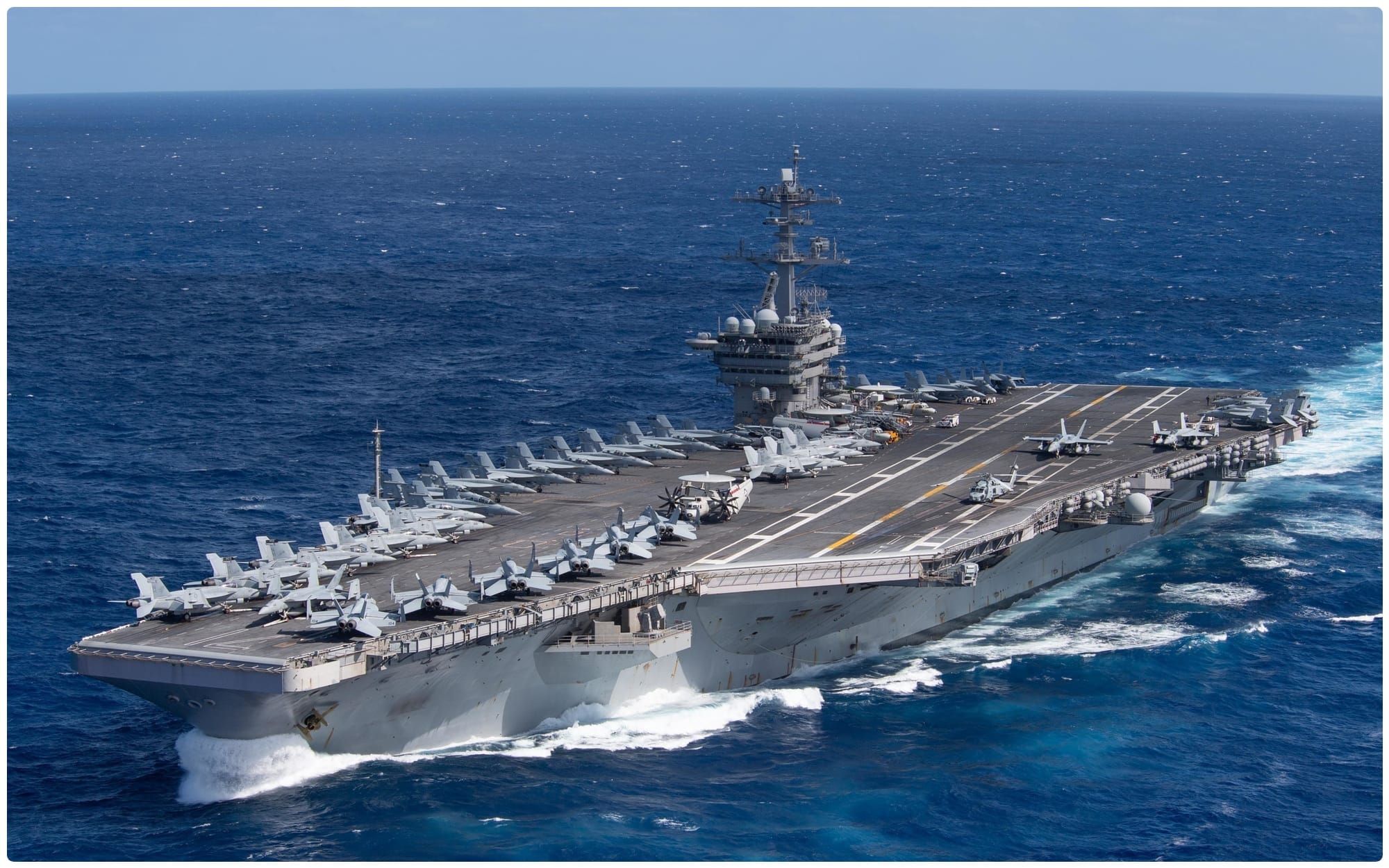
The United States is sending approximately 9,000 additional military personnel aboard seven warships towards the Middle East, substantially increasing its firepower as tensions with Iran rise and the possibility of renewed American strikes returns to the centre of regional calculations.
The deployment includes the USS Theodore Roosevelt aircraft-carrier strike group, three accompanying destroyers and the USS Makin Island Amphibious Ready Group. The amphibious formation includes the Makin Island and two docking ships carrying the 13th Marine Expeditionary Unit.
More than 7,000 sailors and approximately 2,000 Marines are expected to be involved. The ships departed from San Diego earlier this week and are expected to reach the region between late October and the end of November.
Most of the personnel are sailors, aviators and Marines travelling aboard the carrier and amphibious groups. Together, the ships bring fighter aircraft, helicopters, missile systems, amphibious forces and thousands of personnel capable of supporting operations across the region.
Two American aircraft carriers, the USS George H.W. Bush and USS George Washington, are already operating in or near the Middle East. The Theodore Roosevelt could replace one of them as part of a scheduled rotation. However, if both remain when it arrives, the United States could briefly have three carrier strike groups in the region.
That would give Washington an unusually concentrated naval force, including hundreds of aircraft and multiple destroyers capable of launching cruise missiles or intercepting incoming missiles and drones. The presence of amphibious units would also provide commanders with Marines capable of carrying out evacuations, raids, embassy protection or other rapid-response operations.
The deployment comes as President Donald Trump considers his next step against Iran following the breakdown of efforts to secure a broader agreement. Trump has said that renewed military action remains possible if Tehran does not accept what he describes as a fair settlement.
Indirect diplomatic contacts have continued through regional mediators, but major disagreements remain over sanctions, Iran’s nuclear programme, the movement of commercial shipping through the Strait of Hormuz and restrictions affecting Iranian oil exports.
The Strait of Hormuz remains particularly sensitive. It connects the Persian Gulf with the Arabian Sea and carries a substantial share of the world’s traded oil and liquefied natural gas. Any military confrontation affecting the waterway could disrupt shipping, increase insurance costs and push energy prices higher across the world.
Oil markets have already reacted to the heightened risk. Brent crude rose above $100 a barrel as traders considered the possibility of further disruption to Middle Eastern supplies and the consequences of another confrontation between Washington and Tehran.
Iran has warned that any new attack would produce a stronger response. Iranian officials have indicated that retaliation may not be limited to American forces and could extend to countries or installations supporting US operations. American bases, ships and allied infrastructure across the Gulf would therefore face an increased threat if fighting resumes.
The arrival of the Theodore Roosevelt and Makin Island groups does not by itself confirm that new strikes have been ordered. Carrier deployments can be used to deter attacks, protect shipping, reinforce air defences or provide the president with military options without immediately beginning combat.
However, the scale of the buildup sends an unmistakable signal. Washington is positioning sufficient naval and air power to conduct an extended operation if diplomacy fails, while Iran is preparing for the possibility that the current standoff could develop into another period of direct confrontation.